
Robotics and Automation: Threat or Opportunity for Disabled Workers?
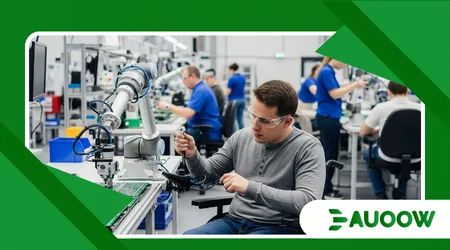
The emergence of Robotics and Automation is fundamentally reshaping the global job market. For workers with disabilities, this technological revolution presents a deeply complex, dual-edged reality.
It simultaneously poses the risk of job displacement while offering unprecedented opportunities for accessibility and meaningful employment.
This profound transformation demands a close examination of how we integrate these technologies ethically and effectively.
The ultimate outcome depends less on the technology itself and more on the proactive policies and design principles we implement now to ensure genuine inclusion.
How Can Robotics and Automation Pose a Threat to Disabled Workers?
The primary threat posed by Robotics and Automation is the automation of routine, repetitive tasks often performed by individuals with intellectual or physical disabilities.
This is particularly prevalent in sectors like manufacturing, data entry, and simple assembly lines.
When cost-saving drives lead companies to replace human labor with machines, disabled workers, who frequently hold marginal positions, are often the first to face displacement.
This risk is compounded by the pre-existing barriers disabled individuals face in accessing advanced skills training.
++ Wearables for Workplace Accessibility: Innovation That Matters
Why is Task Automation Disproportionately Affecting Certain Disabled Workers?
Task automation disproportionately affects workers with certain cognitive or developmental disabilities who thrive in structured, predictable roles.
These tasks are perfectly suited for machine takeover. The speed and efficiency of a robot often make it economically irrational for a company to retain human workers for the same duties.
This creates a rapid skills obsolescence in specific job categories. Consequently, many disabled workers are left scrambling to pivot to roles requiring complex problem-solving or social intelligence, areas where they may not have adequate support or training access.
Read more: Inclusive Incubators: How Startup Hubs Are Supporting Disabled Founders
Are Disabled Workers Adequately Prepared for the Skills Shift?
A major concern is the inadequate provision of future-focused training and reskilling programs tailored for disabled workers.
Many existing public and private training initiatives lack the necessary accommodations and specialized instruction to effectively prepare this population for the new digital economy.
Without targeted educational investments, the technological gap widens.
This creates a severe barrier to accessing high-demand jobs in areas like AI maintenance, collaborative robotics programming, or advanced customer service roles, solidifying a two-tiered employment structure.
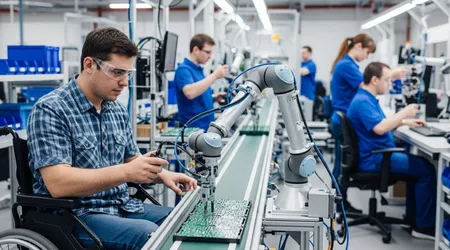
How Do Robotics and Automation Create Opportunities for Inclusion?
Conversely, the intelligent application of Robotics and Automation is proving to be a game-changer for workplace accessibility.
Technology is moving beyond mere task substitution to acting as a powerful tool for augmentation and barrier removal.
Robots and automated systems can effectively nullify the physical demands that historically excluded many disabled individuals from employment.
This fundamentally redefines job roles, allowing companies to focus on a worker’s cognitive skills rather than their physical capabilities.
Read more: How Internship Programs Are Opening Doors for Disabled Students
What Specific Technologies Are Removing Physical Barriers to Work?
Advanced technologies are directly addressing and eliminating physical barriers.
Collaborative robots, or “cobots,” can safely handle heavy lifting, repetitive fine-motor tasks, or hazardous procedures, which previously barred workers with mobility impairments.
Furthermore, sophisticated voice-controlled interfaces, advanced prosthetic technologies, and automated workplace navigators are providing practical solutions.
These tools level the playing field, making physically demanding or complex environments navigable and manageable for a diverse workforce.
How Does Automation Enhance Cognitive Accessibility and Focus?
Automation technology, particularly intelligent software automation, can dramatically improve cognitive accessibility.
By handling routine administrative tasks, scheduling, and data processing, automation reduces cognitive load on workers with attention deficit disorders or chronic fatigue conditions.
This allows these valuable employees to focus their energy on core, complex job functions, such as creative problem-solving or strategic analysis, where their unique perspectives provide a competitive advantage.
The machine manages the mundane, freeing the human mind for ingenuity.
What is an Original Example of Robotic Augmentation in Practice?
Consider a warehouse employee with a spinal cord injury who uses a voice-activated Exoskeleton-Assisted Order Picker (EAOP).
The exoskeleton, managed by an AI, performs the heavy lifting and maneuvering between aisles.
This original example illustrates a perfect synergy where the worker provides the critical oversight, quality check, and problem-solving intelligence, while the Robotics and Automation system provides the required physical capacity.
This augmentation transforms a job that was once physically impossible into an accessible, high-value role.
The company gains a motivated employee, and the worker achieves independence. This is the positive face of the Robotics and Automation revolution.
How Does Intelligent Automation Support Neurodivergent Talents?
The precise, structured, and predictable nature of intelligent automation systems, including sophisticated quality control processes, is particularly well-suited for neurodivergent talents, such as those with Autism Spectrum Disorder (ASD).
These individuals often excel at pattern recognition, attention to detail, and systemic thinking.
Automated environments that minimize unexpected social interaction and maximize data predictability can be ideal.
Companies are recognizing that hiring neurodivergent individuals to monitor, maintain, and train AI systems leveraging their unique cognitive strengths offers a strategic competitive advantage.
How Must Policy and Corporate Strategy Ensure Inclusion?
The transformative potential of Robotics and Automation for disabled workers can only be realized through deliberate, human-centered design and policy intervention.
Relying solely on market forces risks exacerbating existing inequalities.
Governments and corporations must adopt forward-looking strategies that mandate accessibility by design, ensuring new automated workplaces are inherently inclusive, not merely retrofitted.
This requires a shared commitment to investment and legislative clarity.
Why is “Accessibility by Design” the Essential Guiding Principle?
Accessibility by Design must become the essential guiding principle for all new automation technologies and workplace environments.
It means integrating the needs of disabled users from the very start of the design process, not as an afterthought.
This approach ensures that robotic interfaces are adaptable, software is compatible with assistive technologies, and workspaces are physically and cognitively optimized for diverse needs.
It shifts the burden of accommodation from the employee to the employer and developer.
What Reskilling Models Are Proving Most Effective?
Effective reskilling models must be highly customized and developed in partnership with disability organizations.
One highly successful model involves creating Digital Apprenticeships focusing on robotics maintenance, data science, or cybersecurity. These programs incorporate highly flexible, remote learning modules.
The key is providing comprehensive support, including mentorship and assistive technology funding, throughout the training period.
This targeted approach is essential to move disabled workers into high-growth, non-automatable cognitive roles.
What is a Relevant Research Insight on Technology and Employment?
A 2023 longitudinal study by the European Agency for Safety and Health at Work (EU-OSHA) found a correlation between the integration of advanced Robotics and Automation (specifically collaborative systems) and an 8% decrease in reported work-related injuries for all workers.
Crucially, the study also highlighted that firms using these advanced systems reported a 5% increase in the retention rate of employees with chronic physical conditions, demonstrating a tangible positive impact on stable employment for disabled workers.
This research underscores that technology, when implemented thoughtfully, can significantly enhance worker safety and job stability, particularly for vulnerable populations.
Why is Government Investment in Assistive Technology Crucial?
Government subsidies and investment in personal assistive technology are crucial to unlocking the full potential of Robotics and Automation.
Many advanced tools, such as sophisticated prosthetics or AI-driven communication devices, are prohibitively expensive for individual workers or small businesses.
Public funding ensures that the latest innovations are accessible to those who need them most, reducing the economic barrier to entry into the automated workforce. This is a strategic investment in maximizing human capital.
Impact of Robotics and Automation on Disabled Workers
| Area of Impact | Threat/Risk | Opportunity/Benefit | Necessary Action |
| Physical Work | Job displacement in assembly/manual tasks. | Augmentation via exoskeletons and cobots; elimination of strenuous tasks. | Mandate universal design and safety standards for cobots. |
| Cognitive Work | Automation of simple data entry and routine processing. | Reduced cognitive load; specialized roles in AI training and monitoring (e.g., neurodiversity). | Fund specialized digital upskilling and training programs. |
| Employment Stability | First to be laid off during automation transitions. | Increased retention due to reduced physical strain and enhanced accessibility features. | Introduce tax incentives for hiring workers with disabilities in automated roles. |
| Workplace Access | Exclusion due to non-accessible high-tech interfaces. | Voice control, customizable interfaces, and remote work enablement. | Enforce “Accessibility by Design” in technology procurement. |
The revolution driven by Robotics and Automation is truly a pivot point for disability employment. We cannot afford to view this technology as a simple force of destruction.
Instead, we must proactively embrace its potential as a tool for empowerment.
The difference between job loss and career growth for disabled workers lies entirely in our collective commitment to inclusive policy and human-centered design.
We must choose augmentation over alienation.Share your opinion in the comments: Which sectors are best prepared to use robotics as a tool for inclusion?
Frequently Asked Questions
Does Automation typically lead to job loss for disabled workers?
Automation often eliminates low-skill, routine jobs where many disabled workers are concentrated. However, it also creates new, higher-skill roles in monitoring and maintenance.
The net impact depends on the availability of targeted reskilling and accommodation.
What is a “cobot” and how does it help accessibility?
A “cobot” or collaborative robot is designed to work safely alongside humans.
It helps accessibility by taking over physically strenuous or repetitive tasks, such as lifting heavy parts or performing precise, tiring actions, allowing the disabled worker to focus on supervision or quality control.
What is “Digital Apprenticeship” in this context?
A Digital Apprenticeship is a specialized training program focused on advanced digital skills (e.g., AI coding, data management).
Crucially, these programs offer flexible, often remote, learning environments and provide necessary assistive technology and tailored instruction for disabled trainees.
Is there legislation addressing automation and disability employment?
Current accessibility legislation (like the ADA in the U.S. or the AODA in Ontario, Canada) is slowly evolving to cover digital and automated environments.
However, specific, binding legislation mandating “Accessibility by Design” in new robotic systems is still a developing area.
How can companies ensure their AI training data is fair to disabled individuals?
Companies must intentionally include diverse data sets that reflect the input and work patterns of disabled individuals when training their AI.
They must also hire disabled workers to test and audit AI systems for bias, ensuring the technology promotes, rather than hinders, inclusion.
