
Why accessible bus stops still fail disabled commuters in cities
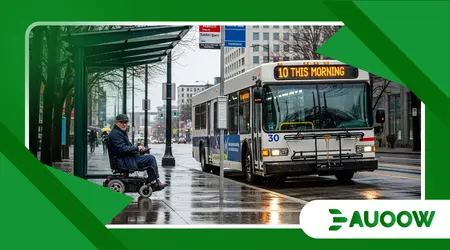
The rain in Seattle has a way of turning a standard sidewalk into a mirror of neon and gray, but for Marcus, a history teacher who uses a motorized wheelchair, the weather is the least of his concerns.
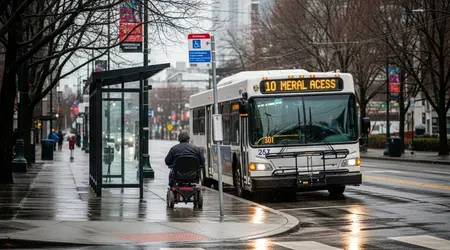
He is currently staring at a two-inch gap. This morning, at a bus stop recently inaugurated with a “Universal Access” plaque, the bus has pulled up exactly four inches too far from the raised curb.
The driver, hurried by a schedule that ignores the physics of mobility, deploys the ramp, but it lands at an angle so steep it mimics a ski jump rather than a pathway.
Marcus watches the bus pull away three minutes later, empty, while he remains on the pavement.
This scene is a quiet, daily indictment of urban planning.
We are told our cities are becoming “smart” and “inclusive,” yet accessible bus stops still fail disabled commuters in cities with a frequency that suggests accessibility is often treated as a finishing touch rather than a foundational requirement.
To understand why this happens, we have to look past the blue wheelchair icons and examine the structural, social, and technical disconnects that turn a “modern” transit stop into a functional island.
Summary of Urban Transit Accessibility Gaps
- The “Travel Chain” Problem: Accessibility is often treated as a spot-fix at the stop, ignoring the broken sidewalks leading to it.
- The Vertical Gap: New low-floor buses often fail to align with old curb heights, creating dangerous boarding angles.
- Information Poverty: Blind and neurodivergent commuters are frequently left out of real-time digital updates and haptic signage.
- Maintenance Decay: Accessible features are the first to fail under budget cuts, with broken lifts and blocked ramps becoming common obstacles.
Why does “compliant” design still lead to exclusion?
When we talk about transit, the focus often gravitates toward the vehicle.
Cities invest millions in low-floor electric buses, yet accessible bus stops still fail disabled commuters in cities because the infrastructure surrounding the bus remains stagnant.
In my fifteen years of observing these shifts, the most glaring error is the “point-based” approach to accessibility.
A city might install a perfectly level boarding platform, but if the sidewalk leading to that platform is cracked, overgrown, or missing a curb cut three blocks away, the stop is effectively non-existent for a wheelchair user.
What rarely enters this debate is the “verticality” of the problem. Modern buses are designed to “kneel,” lowering their suspension to meet the curb. However, many urban curbs were built for a different era of drainage and pedestrian flow.
When the bus and the curb are mismatched by even an inch, the ramp creates a lip that can tip a manual wheelchair or high-center a heavy power chair.
Há um detalhe estrutural que costuma ser ignorado: the lack of “encroachment prevention.” In densely packed cities, delivery vans and ride-share vehicles frequently park in bus zones.
For a non-disabled passenger, this is a minor annoyance; they simply step into the street. For a disabled commuter, a blocked bus bay is a total journey cancellation.
The bus cannot deploy its ramp onto the street without creating a slope that is physically unsafe.
How do decisions from the past dictate today’s barriers?
It is tempting to blame modern technology, but we are living in the shadows of old administrative silos.
In many metropolitan areas, the transit agency owns the bus, but the city’s Public Works department owns the sidewalk. This means that a bus stop is often a “no-man’s land” of responsibility.
When we observe with more attention, the pattern repeats: the transit agency might want a raised curb for easy boarding, but Public Works may hesitate because it interferes with historical drainage patterns or underground utilities installed decades ago.
This jurisdictional friction is a silent barrier to inclusive design.
Decisions made years ago about where to place a fire hydrant or a utility pole now determine whether a blind commuter can safely navigate a boarding zone without walking into an obstacle.
Na minha leitura desse cenário, the current push for “Smart Cities” often ignores these analog failures.
We see apps that tell you exactly when the bus arrives, but no app can tell a person who is blind that the tactile paving at the stop has been worn smooth by years of neglect.
Accessibility is treated as a “project” with a start and end date, rather than a living, breathing maintenance requirement.
++ Accessible Gaming: Top 5 Titles Setting Standards in 2026
What actually changed after the 2024 Global Accessibility Standards?
| Feature | Pre-2024 “Standard” Design | Post-2024 “Inclusive” Vision (2026 Reality) |
| Curb Height | Varied (4–6 inches) | Standardized “Level-Boarding” (8 inches+) |
| Wayfinding | Visual signs only | Integrated Audio & Haptic “Digital Beacons” |
| Ramp Tech | Manual/Heavy Hydraulic | Automatic “Slide-Out” Low-Angle Ramps |
| Information | Static Paper Schedules | Real-time “Accessibility Status” on Apps |
| Waiting Area | Narrow, obstructed paths | 1.5m “Turn-Radius” Clear zones |
Why are we still failing visually impaired and neurodivergent commuters?
The most common failure in urban transit is the assumption that accessibility is purely about wheels.
While physical ramps are vital, accessible bus stops still fail disabled commuters in cities who rely on sensory and cognitive information.
Imagine a blind commuter standing at a busy intersection. The “smart” bus stop has a digital screen showing arrivals, but no audio announcement.
The bus pulls up, but because it is an electric model, it is nearly silent.
Without a haptic signal or a voice prompt from the vehicle, the commuter has no way of knowing if the bus at the stop is their intended route or a different service entirely.
There are good reasons to question the industry’s reliance on smartphones as a catch-all solution.
A significant portion of disabled adults does not have consistent internet access or may struggle with specific interface designs.
When a city removes paper schedules and tactile maps in favor of QR codes, they are effectively creating a digital barrier for many.
Há bons motivos para questionar essa abordagem. If the information isn’t available in multiple formats Braille, audio, and high-contrast visual the infrastructure isn’t accessible; it’s just high-tech exclusion.
The analysis most honest to the facts suggests that we have sometimes replaced physical barriers with informational ones.
Also read: Toothbrush Tech for Disabled Users: The Rise of Y-Brush and Alternatives
The “Human Factor”: Why the driver is part of the infrastructure
Pense em um trabalhador qualificado who happens to use a walker. He arrives at a stop that is physically well-designed.
The curb is the right height, the lighting is bright, and there are benches with armrests.
However, the bus driver, pressured by a performance metric that penalizes them for minor delays, fails to pull close enough to the curb. Or perhaps the driver forgets to announce the stops over the intercom.
In this scenario, the “hardware” of the city works, but the “software” the human element fails.
Training is often treated as a one-time sensitivity workshop rather than a core operational skill.
When drivers view the deployment of a ramp as a “delay” rather than a fundamental duty, the entire system of accessibility collapses.
The pattern repeats across global cities: we spend billions on concrete and steel, but the human labor required to make those tools work is often overlooked.
A bus stop is only as accessible as the person operating the vehicle that docks there.
Read more: Cleaning Made Easy: Accessible Vacuum and Robot Solutions
Is “Universal Design” actually a myth in old cities?
The analysis most honest to the geographic reality of places like London, New York, or Paris suggests that “Universal Design” often hits a wall of heritage.
We are told that narrow sidewalks in historic districts cannot accommodate wheelchair-accessible shelters.
However, this is often a choice of priority rather than a physical impossibility. What rarely enters this debate is the space we give to cars.
We are told there is no room for a 1.5-meter turn radius at a bus stop, yet we maintain street parking for private vehicles on that same block.
When we observe the social forces at play, accessibility failures are almost always a result of a hierarchy of needs.
For decades, the car was at the top, the non-disabled pedestrian was in the middle, and the disabled commuter was an afterthought.
Breaking this hierarchy requires more than a ramp; it requires a redesign of our urban values.
The Way Forward: Beyond the Minimum Requirement
The reality that accessible bus stops still fail disabled commuters in cities will not change until we stop treating accessibility as a “special need.”
Accessibility is, in fact, the ultimate form of urban resilience. A bus stop that works for a wheelchair user also works for a parent with a stroller, an elderly traveler with a suitcase, and a worker with a delivery cart.
Na minha leitura desse cenário, the cities that will thrive in the coming years are those that understand the “Travel Chain.”
We must stop looking at the bus stop as a single point in space and start looking at it as a link in a journey.
This means funding the sidewalks, the lighting, the digital audio feeds, and the driver training with the same intensity we fund the buses themselves.
Accessibility is not a charitable act; it is the fundamental contract of a functioning city.
Until Marcus can catch the bus with the same lack of thought as his neighbors, our “smart cities” are still remarkably dim.
We have the technology and the legislation; what we need now is the resolve to treat the two-inch gap as the emergency it truly is.
Frequently Asked Questions
Why can’t all bus stops be made accessible immediately?
The main hurdle is jurisdictional. In most cities, the land a bus stop sits on is managed by different departments (Transit, Parks, Public Works).
Coordinating these entities to change curb heights and move utility poles is a slow, bureaucratic process that requires consistent political will.
Do “Smart” bus stops really help disabled people?
They can, but only if they follow “Universal Design.” Features like audio announcements of arrival times and haptic ground markers are revolutionary.
However, “smart” stops that only use touch-screens without audio or tactile alternatives can actually decrease accessibility.
What is “Level Boarding” and why is it so rare?
Level boarding is when the bus floor is at the exact same height as the curb, allowing a wheelchair or stroller to roll on without a ramp.
It requires very precise bus docking and specialized “Kassel curbs,” which are more expensive to install across an entire city network.
How can I report an inaccessible bus stop in my city?
Most major cities now have an “ADA Coordinator” (in the US) or an “Inclusion Officer” (in the UK/EU).
You can typically report barriers via a city service line or a dedicated transit app, which helps the city prioritize where to spend its maintenance budget.
