
Wearable Assistive Tech in 2026: What Actually Gets Used Daily
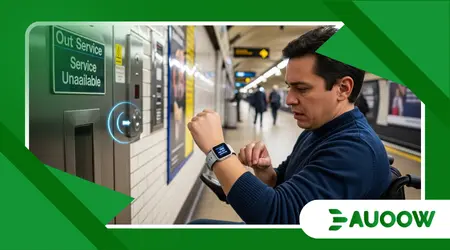
Wearable Assistive Tech in 2026 is often best understood not in a laboratory, but at a crowded subway entrance during rush hour.
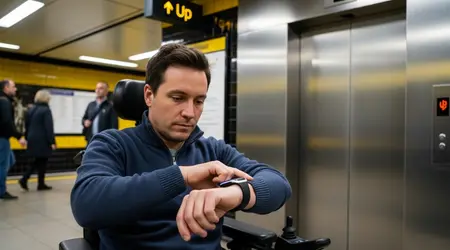
Imagine a commuter in London or New York, someone who uses a motorized wheelchair, staring at a “Service Outage” sign taped to an elevator door.
In previous decades, this was a moment of total isolation a physical and digital dead end.
Today, however, that same commuter doesn’t just wait for help; they glance at a haptic band on their wrist.
It pulses a specific rhythm, notifying them of a secondary accessible route mapped in real-time by other users.
There is no flashy holographic display, no robotic exoskeleton just a subtle, vibrating shorthand that translates a broken city into a navigable path.
- The Shift from Novelty to Utility: Why “invisible” tech is outperforming high-profile gadgets.
- The Haptic Language: How touch-based feedback is solving the cognitive load crisis.
- Economic Barriers: The persistent gap between medical-grade innovation and consumer affordability.
- The Data Privacy Dilemma: Who owns the movement patterns of the disabled community?
- The Road Ahead: Moving beyond “fixes” toward universal sensory design.
Why did the “Iron Man” fantasy fail the disability community?
For years, the tech industry was obsessed with the spectacular. We were promised exoskeletons that would make people “walk again” and complex AR glasses that would subtitle the world in real-time.
But when we look at Wearable Assistive Tech in 2026, those high-profile projects have mostly migrated to niche medical rehabilitation centers or gathered dust in closets.
The reason is structural: these devices ignored the “fatigue factor.” Wearing a ten-pound battery pack or a headset that causes migraines isn’t a solution; it’s a different kind of burden.
What rarely enters the debate is the social cost of looking like a “tech experiment.”
Many people don’t want to be a walking billboard for innovation; they want to go to a cafe without the hardware becoming the primary conversation starter. The industry is finally catching on.
The most successful assistive wearables today are those that integrate with mainstream consumer electronics smart rings, lightweight watches, and woven “smart fabrics” that provide posture support or sensory dampening without drawing unwanted attention.
++ Why Privacy Laws Lag Behind Assistive Technology Innovation
How does sensory substitution change daily navigation?
The most profound shift in recent years involves how we process information. Consider a professional facing barriers that don’t appear in standard regulations.
For a person with low vision, a camera-based wearable that discreetly identifies colleagues or describes the layout of a document is life-changing.
But the real breakthrough in Wearable Assistive Tech in 2026 is haptic feedback.
By using the skin as a data interface, we’ve bypassed the “audio clutter” that often makes traditional assistive tech overwhelming in loud environments.
There is a structural detail that is often overlooked: the brain is remarkably plastic.
When a wearable provides consistent, non-invasive vibrational cues for spatial awareness, the user eventually stops “thinking” about the device. It becomes a sixth sense.
This moves the user from a state of constant, conscious scanning to a state of intuitive flow. It’s the difference between reading a map and simply knowing which way is North.
Why is “Mainstream Integration” a double-edged sword?
There is a tempting narrative that says when major tech corporations include accessibility features, everyone wins. To an extent, this is true.
Mass production drives costs down. However, an honest analysis suggests that mainstreaming often leaves the most complex needs behind.
When a feature is designed for “everyone,” it rarely addresses the specific requirements of someone with a severe motor disability or a non-verbal autistic individual.
We are seeing a market split. On one side, we have the “Lite” accessibility of mass-market wearables.
On the other, we have specialized Wearable Assistive Tech in 2026 that remains prohibitively expensive. This creates a new kind of digital divide.
If insurance only covers a “basic” device, but an advanced haptic vest is what actually allows someone to work a high-intensity job, the technology isn’t actually fostering inclusion it’s reinforcing a glass ceiling based on socioeconomic status.
The Reality Shift: 2021 vs. 2026
| Feature | The 2021 Approach | The 2026 Reality |
| Form Factor | Bulky, conspicuous medical devices | Discreet, integrated into clothing/accessories |
| Interface | Voice-heavy or screen-dependent | Haptic (touch) and gesture-based |
| Battery Life | 4-6 hours (constant anxiety) | 48+ hours or kinetic self-charging |
| Data Flow | Isolated device metrics | Cloud-synced, community-sourced maps |
| Primary Goal | “Fixing” a disability | Expanding environmental interaction |
What actually changed after the 2024 Global Accessibility Standards?
The turning point wasn’t a new chip or a breakthrough in AI, but a change in international policy. Before 2024, assistive tech was often a “walled garden.”
If you bought an aid from one company, it wouldn’t communicate with your home’s smart lock or your city’s transit app.
The 2024 standards pushed for interoperability. This is why Wearable Assistive Tech in 2026 feels more useful: it finally talks to the world around it.
This represents a shift from “compensatory” tech to “participatory” tech. We stopped building devices that tried to replace human functions and started building interfaces that removed environmental friction.
Imagine a student with a visual impairment attending a remote lecture. A few years ago, she might have struggled with lag or poor descriptions.
Today, her wearable syncs with the professor’s digital whiteboard, providing a tactile representation of diagrams on her palm in real-time. The barrier isn’t her sight; the solution is the synchronized data flow.
Also read: Self-Healing Materials in Medical Devices: A Innovation to Watch
Is privacy the next major barrier for assistive users?
When we talk about wearables, we are talking about data. These devices track movement, interaction, and personal habits.
For a person with a disability, this data is extremely sensitive, as it can reveal health trends or specific vulnerabilities.
As we embrace Wearable Assistive Tech in 2026, we must ask: who has the keys to this “digital twin” of a person’s life?
There are valid reasons to question the “data for convenience” approach. Some insurance companies are already looking at wearable data to adjust premiums.
If a mobility aid shows fewer steps, is that a health risk or just a reflection of the weather?
Without strong legal protections comparable to civil rights acts but for the biometric age assistive devices could become tools of surveillance rather than liberation.
The right to move freely must include the right to move privately.
Read more: Why Are Prosthetics Still So Expensive? Breaking Down the Costs
Innovations in Daily Use
- Smart Textiles: Clothing that uses micro-vibrations to correct gait or provide “deep pressure” therapy for anxiety.
- Haptic Navigators: Small bands that vibrate to guide users through complex indoor spaces like airports.
- Gesture-to-Speech Rings: Devices that translate finger movements into synthesized speech for those with limited vocal cord mobility.
- Neuro-Inference Bands: Wearables that detect the electrical intent of a muscle before it moves, allowing for near-instant control of digital interfaces.
Does the “Medical” label hinder innovation?
There is a structural tension in how we categorize these tools. If a device is labeled “Medical,” it undergoes rigorous testing, but it also becomes caught in slow approvals and inflated pricing.
If it’s “Consumer Tech,” it’s fast and cheap but may lack the reliability required for a life-critical aid.
The most successful companies in Wearable Assistive Tech in 2026 are operating in the space between these two worlds.
What is rarely mentioned is how the “Medical” label can stigmatize the user. It reinforces the idea that the person needs “treatment” rather than a society that provides “access.”
The shift toward universal design where a haptic watch is used by a blind person for navigation and a cyclist for directions is a promising path.
It turns an assistive tool into a functional gadget that happens to have life-changing utility for a specific community.
The Evolution of the Interface
The journey of inclusion is not a sprint toward a futuristic utopia; it is the methodical removal of the barriers that make daily life difficult.
Technology, at its best, is an invisible bridge. When we stop talking about the “miracle” of a device and start talking about the ease of the journey, we are on the right track.
The true measure of Wearable Assistive Tech in 2026 isn’t how many features are packed into a chip, but how many people felt confident enough to leave their homes today, knowing the world was finally ready to speak their language.
For a deeper dive into how environmental design interacts with these devices, I recommend exploring the latest findings on Universal Design and Social Integration.
Frequently Asked Questions
Are these devices covered by standard health insurance?
In 2026, coverage is still a patchwork. Most “consumer-grade” wearables are out-of-pocket.
However, “functional wearables” prescribed for specific disabilities are increasingly covered under updated assistive technology acts, though the battle for high-end haptic tech continues.
How do these devices handle “visual noise” or “crowded” data?
Modern wearables use AI-filtering to prioritize information. Instead of notifying the user of everything in a room, the device learns habits and only alerts to relevant obstacles or recognized faces, reducing cognitive load.
Is there a risk of becoming too dependent on this technology?
“Dependency” is a word often used by those who don’t require assistive tools. For the user, this is about “enablement.”
Much like using glasses to read, these wearables are extensions of the self that allow for fuller participation in society.
How long do these devices typically last?
The industry standard in 2026 has moved toward a 3-to-5-year lifecycle.
Most devices now feature modular components that can be upgraded without replacing the entire unit, addressing concerns about high costs and obsolescence.
Can these wearables work without an internet connection?
Yes, “Edge AI” has become the standard. Most critical processing like object recognition or haptic translation happens on the device itself. This ensures the user isn’t left stranded in areas with poor signal.
