
Why accessible travel design is still rare in tourism today

The reason accessible travel design is still rare in tourism today can be found in the quiet, frustrating moments at an airport gate rather than in a glossy brochure.
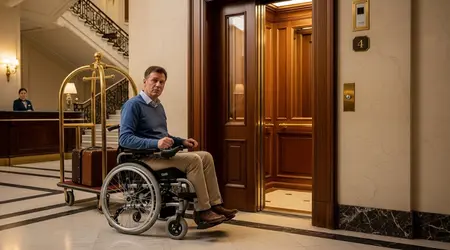
Imagine Julian, a seasoned architect who uses a motorized wheelchair. He spent months planning a trip to a historic European capital.
He checked the hotel’s website, confirmed its status over the phone, and paid a premium for a direct flight to minimize transitions.
Yet, upon arrival, the “accessible” shuttle has a broken lift. The hotel’s elevator is two inches too narrow for his chair. The cobblestone streets, while charming to others, are a jarring, impassable labyrinth.
Julian’s experience is not an anomaly; it is the standard friction of a world built for a “default” body that simply does not exist for millions of people.
- The Aesthetic Myth: Why designers often choose “charm” over inclusion.
- The Fragmented Journey: The disconnect between airlines, hotels, and city infrastructure.
- Economic Misconceptions: Why the “Purple Pound” is being ignored by major developers.
- Legacy Barriers: How historical preservation acts as a shield against progress.
- The Digital Information Gap: The lack of reliable, standardized data for travelers with disabilities.
Why does the tourism industry prioritize “vibes” over utility?
For a long time, the hospitality sector has operated under the assumption that accessibility is a medical requirement rather than a design standard.
What rarely enters this debate is the psychological barrier created by “clinical” design.
When a hotel does implement accessibility, it often feels like a hospital ward fluorescent lighting, cold grab bars, and a lack of the artistic soul found in the rest of the property.
The analysis more honest suggests that accessible travel design is still rare in tourism today because the industry views inclusion as a chore.
There is a persistent, unspoken fear among developers that universal design will “ruin the aesthetic” of a luxury brand. This is a profound failure of imagination.
Truly great design is invisible; it serves everyone without shouting its presence or compromising beauty.
++ The reality of metro accessibility audits in major cities today
How do historical preservation laws stall progress?
When observing with more attention, the pattern repeats in almost every historic city center. We hear the same refrain: “We cannot add a ramp because the building is protected.”
This creates a static version of history that excludes anyone who doesn’t navigate the world on two feet. It treats heritage as something to be looked at, rather than lived in.
There is a structural detail that is often ignored here. Many of these preservation laws were written in an era when people with disabilities were largely invisible in public life.
By clinging to these rigid standards, we aren’t just protecting stones; we are protecting a legacy of exclusion.
Modern engineering allows for non-invasive, reversible accessibility solutions, yet the bureaucracy often remains several steps behind the available technology.
Also read: How Smartwatches Are Saving Lives for Epileptic and Cardiac Patients
Why is the travel “chain” so easily broken?
A trip is only as accessible as its weakest link. A traveler might find an accessible flight and an accessible hotel, but if the sidewalk between the two lacks curb cuts, the entire journey fails.
In my reading of this scenario, the tourism industry suffers from extreme silo-ing. Airlines rarely coordinate with city planners, and city planners often don’t talk to tour operators.
Think of a traveler with a visual impairment navigating a modern airport.
The digital kiosks might be high-tech, but if they lack tactile markers or screen-reading capabilities, they are useless.
Even in 2026, accessible travel design is still rare in tourism today because we treat accessibility as a series of isolated checkboxes rather than a continuous, end-to-end human experience.
Is the “cost” of accessibility a valid excuse?
Industry leaders often cite the high cost of retrofitting as a primary barrier. However, the analysis more honest suggests that this is a short-sighted perspective.
The global “disability market” including friends and family who travel with people with disabilities represents trillions of dollars in spending power.
By failing to design for this demographic, businesses are essentially leaving money on the table.
There are good reasons to question this “high cost” narrative. When universal design is integrated from the initial planning phase, the cost increase is often negligible.
The real expense comes from fixing mistakes later.
There is a detail that is often ignored: a ramp is useful for a wheelchair user, but it is also useful for a parent with a stroller, a traveler with heavy luggage, or an elderly person with limited mobility.
What actually changed after the 2024 Global Inclusion Mandates?
Two years ago, several major international bodies introduced stricter guidelines for digital transparency in travel. The goal was to ensure that “accessible” actually meant usable.
| Feature | Pre-2024 Standards | 2026 Reality |
| Room Descriptions | Vague labels like “handicap-friendly.” | Specific measurements for door widths and bed heights. |
| Airline Policy | Wheelchairs often treated as standard luggage. | Mandatory digital tracking and improved handling protocols. |
| City Navigation | Reliance on physical maps or generic GPS. | AI-driven “smooth path” routing for mobility devices. |
| Staff Training | Minimal or non-existent. | Certified empathy and assistance training in major chains. |
While these shifts are promising, the implementation is uneven.
When we observe with more attention, the pattern repeats: top-tier luxury brands and newest tech-driven startups are moving forward, while the vast “middle market” of travel remains stuck in the past.
This creates a two-tiered system where inclusion becomes a luxury rather than a fundamental right.
Why is reliable data still so hard to find?
Imagine a traveler who uses a ventilator trying to find a hotel that guarantees a consistent power supply and distilled water. Even with the best search engines, this information is rarely verified.
Accessible travel design is still rare in tourism today because the digital infrastructure of travel was built on a foundation of “average” needs.
There is a detail that is often ignored: the lack of a standardized global rating system for accessibility. A “Level 1” accessible room in London might look completely different from one in Tokyo.
This lack of certainty creates a “travel anxiety” that prevents many people with disabilities from ever booking a trip.
They aren’t just afraid of a bad hotel; they are afraid of being stranded in a foreign city with no way to navigate back to safety.
How does the “empathy gap” impact policy?
The analysis most honest suggests that the people making the decisions the CEOs of airlines, the architects of resorts, the ministers of tourism rarely live the reality of disability.
They see accessibility as a set of technical specifications to be met, rather than a human right to be honored.
There are good reasons to question this approach. When we invite people with lived experience into the design room, the solutions change.
They stop being about “compliance” and start being about “belonging.” We see this in small, boutique hotels that have adopted the “Nothing About Us Without Us” mantra.
These spaces aren’t just accessible; they are welcoming. They prove that inclusion is a creative opportunity, not a burden.
Read more: Accessible Office Tools: Top 10 Apps for Disabled Professionals
What is the role of technology in 2026?
We are seeing a rise in “augmented accessibility.” Apps that use LiDAR to scan a room in real-time can tell a traveler if their chair will fit before they even unpack.
Wearable tech can translate sign language for a concierge. However, we must be careful not to use tech as a “digital ramp” for a physically broken world.
If accessible travel design is still rare in tourism today, technology can only do so much. A high-tech app cannot lift a wheelchair over a six-inch step.
We must avoid the trap of thinking we can “app our way” out of a lack of physical inclusion. The foundation must be physical; the technology should be the enhancement, not the replacement.
The Path Toward a Truly Open World
The journey toward a more inclusive tourism sector is not a sprint; it is a slow restructuring of how we value human movement.
If accessible travel design is still rare in tourism today, it is because we have allowed the “convenience of the majority” to dictate the layout of our world.
The real change will come when we stop seeing accessibility as a niche market and start seeing it as a hallmark of quality.
A world that is easy to navigate for Julian is a world that is easier for everyone. We are moving toward a future where “travel for all” is not a slogan, but a reality.
But that future requires us to look at our cobblestones, our airplanes, and our digital interfaces with a new, more empathetic eye.
The stones of our historic cities may be fixed, but our mindset is not. It is time to design a world that is as wide as the horizons we seek to explore.
FAQ: Understanding the Gaps in Travel Design
1. Why are newer hotels still being built with barriers?
Often, architects follow the minimum legal requirements rather than universal design principles. Legal compliance does not always equal practical usability.
2. Is “accessible” the same as “universal” design?
No. Accessible design often adds features (like a ramp) specifically for people with disabilities. Universal design creates a space that is inherently usable by everyone, regardless of age or ability, without the need for adaptation.
3. Why do airlines still damage so many wheelchairs?
Cargo holds were designed for luggage, not complex medical devices. Until planes are redesigned with dedicated cabins for mobility devices, this remains a systemic risk.
4. Are some countries better at this do others?
Yes, but it’s not always who you’d expect. Some developing nations with newer infrastructure have leapfrogged older European cities because they aren’t hampered by the “historical preservation” barrier.
5. How can I verify a hotel’s accessibility?
Beyond websites, look for crowd-sourced reviews from the disability community and ask for specific photos of bathroom layouts or entrance steps.
