
When Automation Replaces Jobs That Were Already Hard to Access
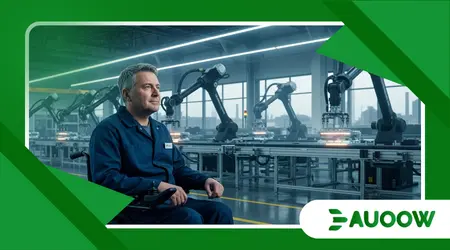
The morning shift at a distribution center on the outskirts of Manchester begins not with human chatter, but with the rhythmic, pressurized hiss of pneumatic arms.
For David, a floor supervisor who has navigated this facility in a wheelchair for fifteen years, that sound used to represent a hard-won victory.
It took a decade of advocacy to ensure the loading bays were ramped, the consoles lowered, and the safety sensors calibrated to recognize a seated frame.
But as of this spring, those modifications are being dismantled to make room for a fully autonomous sorting grid.
When Automation Replaces Jobs that were already hard to access, we aren’t just looking at a shift in the labor market; we are witnessing the silent erasure of the very spaces that disabled workers fought to inhabit.
- The Vanishing Entry Point: How entry-level roles often the gateway for disabled workers are the first to be automated.
- The “Neutral” Algorithm: Why automated hiring systems inadvertently filter out non-standard career paths.
- The Digital Ceiling: The transition from physical labor to “knowledge work” and the new barriers it creates.
- Policy Gaps: A look at why current labor protections fail to address technological displacement for the marginalized.
Why does the “efficiency” of a machine feel like a step backward for inclusion?
There is a recurring irony in the way we discuss technological progress.
The narrative suggests that robots will take over the “dull, dirty, and dangerous” tasks, supposedly freeing humans for more creative pursuits.
However, for a significant portion of the disabled community, those repetitive roles in manufacturing, data entry, or retail were often the few positions where reasonable accommodations were consistently implemented.
These were predictable environments where a worker could establish a routine and demonstrate their professional value.
When a self-checkout kiosk replaces a cashier, or an AI bot replaces a customer service representative, a specific, accessible niche in the economy simply evaporates.
What rarely enters this debate is the concept of “infrastructure investment.”
A company that spends significant resources to make a workstation accessible for an employee is making a long-term social commitment.
When that workstation is replaced by a machine, that social investment is often written off as a sunk cost.
When Automation Replaces Jobs, the physical modifications the braille keypads, the lowered desks, the widened aisles become obsolete.
The machine doesn’t need a ramp. Consequently, the workplace can physically revert to a state of exclusion, making it even harder for the next human applicant with a disability to even enter the building.
++ Human Augmentation vs Assistive Technology: Where Do We Draw the Line?
Is the move toward “Knowledge Work” actually more accessible?
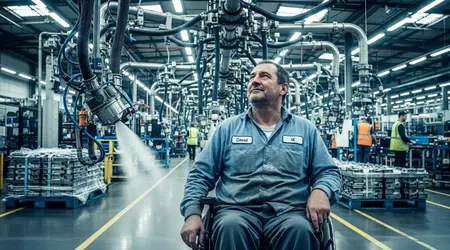
A pervasive myth suggests that as the economy shifts toward digital and cognitive labor, accessibility will naturally follow.
The logic seems sound: if you only need a laptop and an internet connection to work, then physical mobility shouldn’t matter.
But this assumes that digital environments are inherently neutral. In practice, we are often merely swapping physical stairs for digital ones.
Many of the proprietary software suites used in modern automated offices remain hostile to screen readers or voice-command software.
There is a structural detail often overlooked: the “cognitive tax” of automation.
As AI takes over routine aspects of a job, the remaining human tasks often become more complex, intense, and socially demanding.
For neurodivergent individuals who excelled in structured, repetitive environments, this shift toward high-pressure “soft skill” roles can be disqualifying.
We risk narrowing the definition of a productive worker to a very specific type of neurotypical individual.
The more we automate the “simple” tasks, the more we inadvertently raise the barrier of entry for those who rely on those roles to enter the workforce.
How did the 2024 Global Employment Accord fall short?
Two years ago, international leaders signed a framework intended to protect workers from the AI revolution.
It was hailed as a landmark in labor rights, but for many in the disabled community, it felt like a document written for a world that does not prioritize them.
The accord focused heavily on retraining and upskilling for the general population.
But the question remains: how do you upskill a worker when the very training platforms used by the company are not accessible?
| Policy Area | General Workforce Impact | Impact on Disabled Workers |
| Retraining Grants | Subsidized courses for new tech roles. | Often used on platforms incompatible with assistive tech. |
| Severance Packages | Standardized 3-month payouts. | Fails to account for longer job-search times due to systemic bias. |
| Remote Work Rights | Right to request “work from home.” | Often tied to digital literacy levels that aren’t universally accessible. |
| Hiring Algorithms | Faster processing of applications. | AI “gap detection” penalizes those with medical-related career breaks. |
The evidence suggests that these high-level policies treat the workforce as a monolith.
When Automation Replaces Jobs, a non-disabled worker might find a new role in four months; a disabled worker, facing systemic bias and physical barriers, often takes significantly longer.
By failing to bake inclusive transition into the 2024 Accord, the message sent to millions was that their displacement was an acceptable price for economic speed.
Also read: Self-Healing Materials in Medical Devices: A Innovation to Watch
Can an algorithm be “unintentionally” discriminatory?
Consider a skilled professional, perhaps a veteran with PTSD or a graduate with severe dyslexia, trying to pass through an initial hiring filter driven by AI.
Many modern companies use automated video interviews where an AI analyzes facial expressions, tone of voice, and eye contact to determine “cultural fit.”
For someone with autism or facial paralysis, these systems can act as a digital “Do Not Enter” sign.
The machine is often programmed to look for a specific type of enthusiasm or confidence rooted in neurotypical norms.
The problem isn’t necessarily that programmers are prejudiced; it is that the training data used to build the AI is often devoid of disabled examples.
If the machine only knows what a “successful employee” looks like based on a pool of non-disabled people, it may view any deviation as a deficiency.
When Automation Replaces Jobs, and the hiring for those remaining positions is also automated, the cycle of exclusion becomes self-perpetuating.
We aren’t just losing the jobs themselves; we are losing the human recruiters who might have had the empathy or the lived experience to see talent where a machine sees a glitch.
Why are we ignoring the “Hidden Logistics” of home-based work?
Imagine a student with a chronic fatigue condition who lands a remote data-entry job, only to find that the automated productivity tracker installed on her computer flags her as “inactive” every time she needs a ten-minute rest.
The push for automation isn’t just about robots on a factory floor; it’s about the “algoritmization” of management.
When the oversight is a line of code designed to maximize every second of the hour, there is often no room for the flexibility that many disabled people require to function effectively.
There is a profound economic incentive for companies to ignore these nuances. It is significantly cheaper to apply a “one-size-fits-all” software solution than to create personalized workflows.
This “uniqueness tax” the idea that accommodating a non-standard body or mind is an extra expense is being encoded into our digital tools.
We are building a high-speed economy on a track that is often too narrow or too loud for diverse needs. The digital divide threatens to become a permanent trench.
Read more: Predictive Health Alerts in Assistive Devices: A Life-Saving Trend?
What is the human cost of “Frictionless” service?
We should question why we prioritize “frictionless” consumer experiences over the dignity of the person providing the service.
We celebrate a world where an item appears at the door without a single human interaction. But human interaction was often the very thing that allowed for accommodation.
A human delivery driver might wait an extra minute for a person with limited mobility to reach the door; an autonomous drone or a sidewalk robot will simply register a “failed delivery” and move on.
The loss of these small, human adjustments is a significant blow to independent living. When Automation Replaces Jobs, it also replaces the human “buffer” in our social systems.
A society that works for a person with a complex disability is inherently more resilient for everyone.
When we remove humans to save a fraction on the bottom line, we aren’t just losing employees we are losing the eyes and ears that help a community stay cohesive.
A robot doesn’t notice when an elderly neighbor hasn’t come out for their mail; a human worker does.
How do we move from “Retrofitted Access” to “Universal Design”?
The goal for the next decade of labor policy must be the move from “reasonable accommodation” which is often a reactive, legalistic term to “Universal Design” in automation.
We shouldn’t be asking how to fix an AI after it has already filtered out a disabled worker; we should be building AI that recognizes and values diverse ways of working from the start.
This means having disabled developers and ethicists in the rooms where these algorithms are designed, not just as a “diversity check,” but as primary architects.
The pattern of cutting corners during a technological rush reflects whose lives are considered “standard.”
If we continue to view disability as a niche edge-case, the automated future will be a very lonely place for many.
But if we recognize that every human will, at some point in their life, experience a limitation in their abilities, then inclusive automation becomes a benefit for everyone.
The technology is here; the instructional imagination is what we must cultivate.
The Ethics of the Next Horizon
The true test of a technological revolution is not how many tasks it can perform, but who it leaves standing when the transition is over.
As we march toward 2030, the conversation around Automation Replaces Jobs must shift from “profit vs. loss” to “inclusion vs. exclusion.”
We cannot afford to treat human diversity as a bug in the system that needs to be smoothed out for the sake of a frictionless algorithm.
True resilience is found in the reach of our empathy.
By integrating the lived experience of the disabled community into the very DNA of our automated strategies, we create a world that isn’t just more efficient but one that is finally, truly accessible to all.
The machine may be the future, but the human must remain the purpose.
FAQ: Automation and Inclusion
1. Does automation always mean fewer jobs for disabled people?
Not necessarily. Automation can remove physical barriers, but only if the technology is designed with accessibility in mind from the start. The current risk lies in choosing speed over inclusive design.
2. Why can’t disabled workers just “upskill” to tech jobs?
Many want to, but training programs and hiring platforms often have their own barriers. Upskilling requires accessible education, which remains a hurdle in the automated learning era.
3. Is there legal protection against AI hiring bias?
Some jurisdictions are beginning to pass laws requiring audits of hiring algorithms, but these protections are often years behind the actual technology being used.
4. How does “Remote Work” impact this issue?
Remote work can remove the commute, but it often introduces digital surveillance tools that can penalize workers who need flexible breaks or use assistive software.
