
How Video Interviews Can Exclude Candidates with Different Communication Needs
The waiting room of a traditional hiring cycle used to be a physical space a fluorescent-lit corridor, a squeaky chair, a quiet exchange of polite nods.
Today, that room has been replaced by a glowing web browser window, where video interviews have become the primary gatekeeper for millions of job seekers worldwide.
Consider Marcus, a talented systems architect based in Chicago who happens to have a pronounced stammer.
A few years ago, an interview meant sitting across a table from a hiring manager who could observe his composure, his deep technical comprehension, and his thoughtful demeanor despite the occasional pause.
Last month, Marcus sat alone in his room, staring at a countdown timer on his laptop screen.
He had two minutes to answer a complex prompt about cloud infrastructure, recorded via an automated platform.
As his speech blocked on the second question, the timer ran out relentlessly.
The software captured his silence, flagged his anxiety metrics, and moved on. Marcus was rejected before a human being ever reviewed his application.
Quick Navigation
- The Silent Shift from Conversation to Computation
- Why Standard Assessment Metrics Miss Human Complexity
- Historical Precedents in Recruitment Discrimination
- Communication Variations vs. Technical Competence
- Structural Obstacles in Automated Recruitment Platforms
- Practical Steps Toward Equitable Talent Evaluation
- Frequently Asked Questions
What Happens When Human Conversation Is Replaced by Automated Filters?

The broad adoption of video interviews particularly one-way, asynchronous formats where candidates record responses without a human interviewer was intended to democratize recruitment.
Corporate leaders believed it would standardize evaluations, remove local biases, and speed up hiring processes significantly across global markets.
Yet, when we examine how these systems operate in practice, a fundamental flaw emerges.
Automated video tools evaluate candidates using criteria that reward a narrow band of communication styles.
They analyze vocal inflection, eye contact, facial movement, and speech pacing.
What rarely enters this debate is how profoundly these metrics penalize individuals with neurodivergence, speech impairments, hearing loss, or non-standard communication patterns.
An autistic professional who avoids direct eye contact, or a candidate who uses an augmentative and alternative communication (AAC) device, is judged against an algorithm calibrated for typical speech and body language.
When we observe with more attention, the pattern repeats across industries.
The push for corporate efficiency quietly erects structural barriers under the guise of technological neutrality, creating systemic obstacles for qualified job seekers.
Are We Measuring Competence or Conformity?
There is a structural detail that tends to be ignored in corporate hiring discussions: fluency is not synonymous with capability.
A software engineer does not code in rapid-fire public speeches, nor does a financial analyst evaluate risk through animated facial expressions.
When standardized platforms rely heavily on video interviews, they obscure this distinction.
They transform an assessment of professional skill into a test of performative fluency under unnatural, high-pressure conditions.
A candidate who relies on an AAC device or requires extra processing time is not lacking in professional knowledge; they are operating outside the narrow parameters of automated software built for standardized interactions.
In my years observing corporate policy shifts, I have seen how organizations fall into the trap of believing that identical treatment equals fair treatment.
Requiring every candidate to record an unedited two-minute video response seems equal on paper.
In reality, it disfavors those whose communication requires flexibility, alternative modalities, or reasonable accommodations.
++ How disability hiring incentives could reshape small businesses
How Did Past Hiring Practices Shape Today’s Digital Gatekeepers?
To understand how modern recruitment excludes talent, we have to look back at the history of standardized testing and employment screening.
In the mid-20th century, broad cognitive and personality assessments were introduced across major public and private institutions with similar promises of objectivity.
Over time, researchers and civil rights advocates demonstrated that those standardized tests were biased toward dominant cultural norms, systematically excluding marginalized groups and individuals with cognitive differences.
Legislative milestones, such as the Americans with Disabilities Act of 1990 (ADA) and similar global frameworks, were designed to force employers to evaluate candidates based on their essential job functions rather than arbitrary physical or communicative standards.
Yet, as recruitment transitioned into the digital age, those hard-won lessons were temporarily forgotten.
Modern AI-driven video interviews essentially package old discriminatory practices into sleek, modern user interfaces.
The digital transformation of human resources bypassed many of the accessibility protocols established decades ago, creating a paradox where hiring systems became technically more advanced while socially regressing.
Also read: How Skills-Based Hiring Could Benefit Professionals with Disabilities
What Makes Asynchronous Evaluation Particularly Exclusionary?
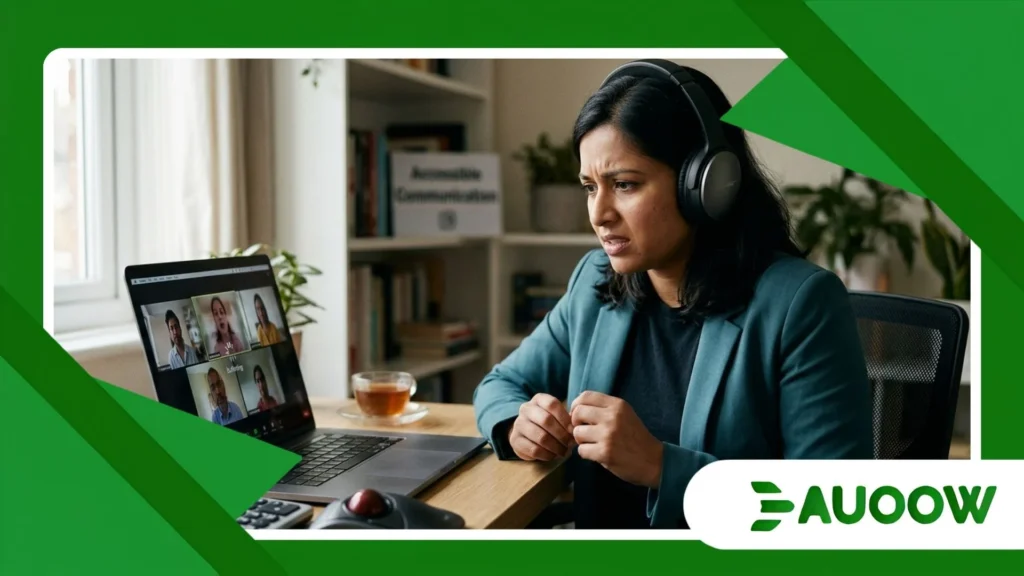
The environment of a recorded assessment creates specific hurdles that rarely appear in live, interactive dialogues.
Understanding these hurdles requires breaking down how different communication needs interact with rigid software design.
Processing Time and Time Constraints
Many platforms impose strict response limits often 60 to 180 seconds per question with immediate automatic cutoffs.
- Impact on Stammering: The pressure of a visible countdown timer frequently heightens blocks, making fluid delivery difficult within arbitrary time windows.
- Impact on Neurodivergence: Individuals who process information differently or experience sensory overload need additional seconds to structure thoughts coherently.
- Impact on Foreign-Language Speakers: Candidates processing complex technical topics in a second language are disproportionately disadvantaged by artificial speed demands.
Algorithmic Facial and Vocal Analysis
Some advanced evaluation suites use computer vision and audio analytics to grade traits like confidence, enthusiasm, or clarity.
- Facial Expressiveness: Conditions like Parkinson’s disease, facial paralysis, or certain forms of autism naturally result in flatter facial affect, which algorithms misinterpret as disinterest.
- Eye Contact Metrics: Webcams require looking into a lens rather than a human face. For many neurodivergent candidates, forced camera engagement causes cognitive distress, lowering performance overall.
Read more: Robotics and Automation: Threat or Opportunity for Disabled Workers?
Who Benefits from Streamlined Recruitment, and Who Is Left Behind?
From an operational standpoint, the appeal of standardized corporate evaluation tools is clear.
Human resource departments facing thousands of applications per opening rely on automated filters to manage volume efficiently.
The analysis suggests that efficiency has often been prioritized over equity.
The primary beneficiaries of this setup are large enterprises looking to cut recruiting costs and the software vendors selling automated screening tools.
The individuals left out are candidates with diverse speech patterns, deaf and hard-of-hearing professionals, neurodivergent thinkers, and ultimately, companies that miss out on extraordinary talent due to algorithmic blindness.
When relying on automated video interviews, organizations filter out candidates who do not fit a standardized mold, effectively shrinking their own talent pools and undermining their corporate diversity goals.
How Do Automated Platforms Compare to Accessible Practices?
The contrast between rigid automated screening and accessible evaluation frameworks highlights how structural adjustments alter candidate outcomes.
| Assessment Dimension | Standard Automated Video Interview | Accessible & Inclusive Evaluation Framework | Social and Professional Impact |
| Response Format | Rigid video recording with hard timers | Choice of written, live verbal, or recorded formats | Allows candidates to demonstrate skills in their strongest medium. |
| Time Limits | Strict per-question limits (e.g., 90 seconds) | Untimed responses or extended accommodation options | Eliminates artificial anxiety and accommodates processing differences. |
| Interface Design | Facial recognition & automated tone scoring | Human-reviewed content focused strictly on answers | Removes algorithmic bias against atypical facial affect or speech blocks. |
| Feedback Loop | One-way transmission; no candidate questions | Two-way dialogue with live context and clarification | Enables candidates to ask questions and assess company culture. |
| Accommodation | Hidden or difficult-to-request opt-outs | Proactively offered alternative pathways without stigma | Normalizes accessibility rather than penalizing those who request it. |
Rethinking Candidate Evaluation Beyond Screen-Based Metrics
Rebuilding trust in recruitment requires moving away from the belief that automated video interviews are fair simply because they treat everyone identical.
True accessibility requires recognizing that fairness means offering equal opportunities to demonstrate competence, even if the method of demonstration looks different from person to person.
Organizations must critically re-evaluate their reliance on automated asynchronous screening as an initial gatekeeper.
Employers can start by making video assessments strictly optional, offering alternative submission formats like written case studies, technical tests, or live human conversations.
Crucially, hiring managers must be trained to separate presentation style from functional talent and practical problem-solving capabilities.
As workplace technology continues to evolve, the goal must not be to automate human interaction out of recruitment, but to design hiring workflows that honor human variation and personal context.
A truly inclusive job market is one where every qualified professional regardless of how they speak, look, move, or process information has a genuine, equitable chance to step through the door and show what they can bring to the table.
Restoring humanity to talent evaluation ensures that capability, wisdom, and technical insight always take precedence over algorithmic compliance and performative metrics.
Frequently Asked Questions
Are video interviews legal under existing disability rights laws?
While video interviews themselves are legal, using them without offering reasonable accommodations or using automated scoring systems that discriminate against individuals with disabilities can violate laws such as the Americans with Disabilities Act (ADA) in the United States and equivalent international accessibility mandates.
How can candidates with speech or processing differences request accommodations?
Candidates can contact the hiring team or HR contact listed on the job posting before completing the assessment.
You can request specific adjustments, such as extended response timers, a live interview with a human, or an alternative written submission format.
Do automated video interview tools really use AI to grade candidates?
Some platforms use AI to analyze speech cadence, vocabulary, and facial expressions, while others simply record videos for human recruiters to review later.
However, even one-way videos reviewed by humans can trigger unconscious bias against candidates with non-standard communication styles.
What can companies do to make early-stage candidate screening more inclusive?
Companies can offer multiple submission formats (such as written exercises or portfolio reviews), remove arbitrary time limits on asynchronous questions, eliminate automated facial/tone scoring, and ensure that human interviewers are trained on communication diversity and accessibility accommodations.
