
How accessible park trails make outdoor recreation more inclusive
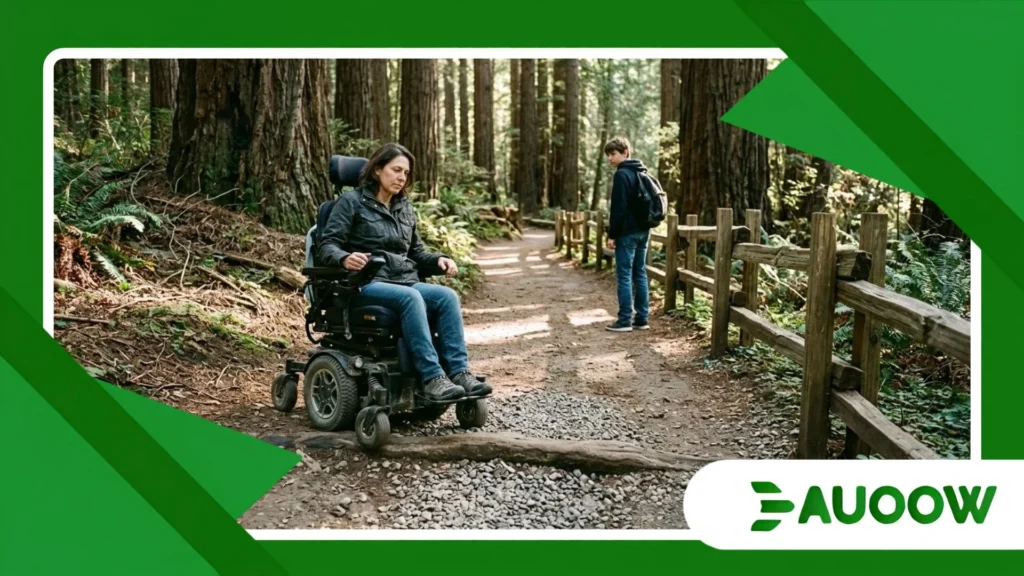
The front caster wheel of Elena’s power chair hit a loose pocket of river gravel forty yards past the trailhead, shifting the afternoon’s plan in half a second.
She leaned slightly back to test the angle of the slope while her teenage son paused ahead near a split-rail fence that looked rustic in photographs yet functioned like a wall in real life.
Above them, redwoods filtered the light into long stripes across the path, and birds moved through the canopy without noticing a thing.
Down on the ground, a four-inch lip of exposed tree root and a steep cross-slope turned a simple walk into a negotiation with physics.
When trail designers consider how accessible park trails make outdoor recreation more inclusive, they rarely focus on a ribbon-cutting or a sign with a wheelchair icon; instead, they ask whether a family can stay together past the first bend without someone having to turn around.
At a Glance: Key Takeaways
- Trail design shapes belonging: Surfacing, grade, cross-slope, and rest areas determine who can actually reach an overlook or picnic grove rather than staying near the parking lot.
- Old assumptions still linger: Many public parks were laid out around ruggedness and able-bodied endurance long before federal standards and universal design entered park planning.
- Daily life tells the real story: Real inclusion shows up in ordinary details benches placed where people pause, clear tactile and visual cues, and routes that welcome strollers, older adults, and wheelchair users alike.
- Policy needs maintenance: Passing guidelines or building a short loop means little when erosion, poor drainage, or blocked gates go unaddressed.
Why Do So Many Scenic Trails Still Stop People at the Edge?
Walk into many municipal parks or county forest preserves on a Saturday morning and you will see two parallel realities.
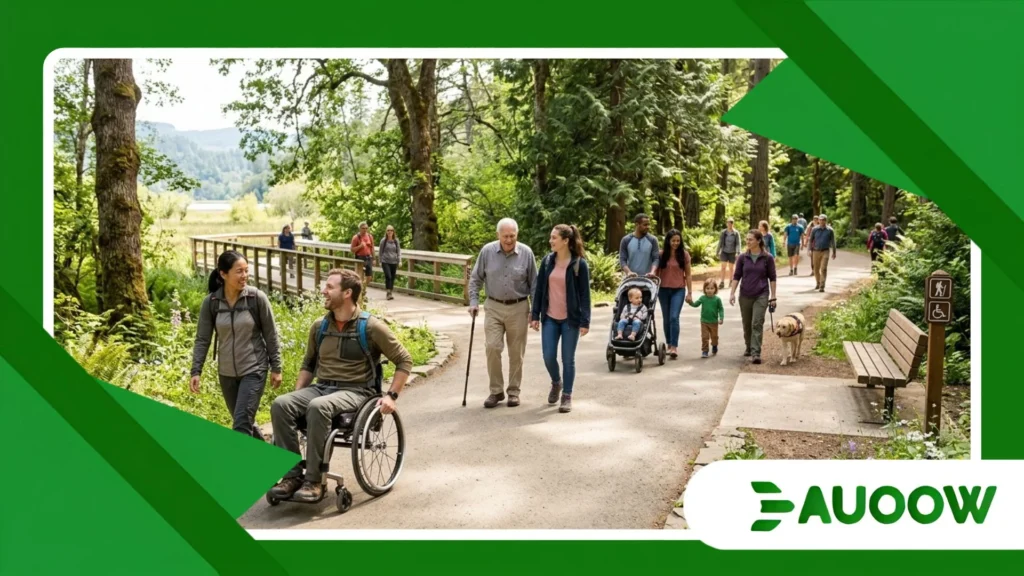
Near the paved lot, people gather around picnic tables, push strollers, or walk slowly with a cane.
Fifty yards in, where the pavement gives way to uneven dirt or deep sand, the crowd thins out in ways that rarely make it into park attendance reports.
What rarely enters this debate is how much of that separation gets treated as natural scenery rather than a design choice.
For decades, outdoor culture equated “authentic” nature with obstacles steep switchbacks, jagged rocks, narrow bridges, and rutted soil.
Those features certainly challenge hikers seeking strenuous terrain, yet treating every path as a test of balance or upper-body endurance quietly excludes plenty of neighbors before they even reach the view.
There is a structural detail that often gets overlooked when budgets tighten: a trail that looks “passable” at a glance can still fail someone using a manual wheelchair, a walker, or a white cane.
Loose aggregate shifts under tires and tips crutches off balance.
A cross-slope steeper than two percent can pull a wheelchair sideways toward the ditch, forcing steady muscle effort just to hold a straight line.
Seen closely, outdoor access has too often been framed as a special accommodation tacked onto a finished park rather than part of how public land serves a broad community.
When a park system builds one short, flat loop near the restroom and leaves the rest of the acreage impassable, it creates a pocket of access while keeping broader landscapes out of reach.
Can a Trail Be Both Natural and Predictable Underfoot?
People sometimes worry that smoothing a path ruins the wild feel of a park.
That fear comes from a real place nobody wants a dense forest turned into a suburban shopping concourse but it often exaggerates the trade-off.
Hard-packed crushed stone bound with natural stabilizers, compacted earth with proper drainage, and timber boardwalks with flush transitions can blend quietly into woodland or meadow settings. Predictability is what turns anxiety into ease.
When a path offers firm footing, clear edges, and gentle grades, a person with low vision can read the corridor more reliably with a cane or guide dog, and someone experiencing joint pain or fatigue can pace themselves without bracing for sudden drops.
++ How Indoor Navigation Technology Is Improving Accessibility
How Did Old Park Traditions Shape Today’s Barriers?
To understand why outdoor spaces still put up friction, it helps to look backward rather than treating exclusion as a recent oversight.
In the United States, the Architectural Barriers Act of 1968 and the Rehabilitation Act of 1973 began requiring federal facilities and federally funded programs to be accessible, followed years later by the Americans with Disabilities Act of 1990.
Those laws marked major turning points, yet outdoor recreation lagged behind indoor buildings for a long time.
Early debates in park management often argued that wilderness and natural trails were fundamentally different from courthouses, schools, or buses.
Agencies wrestled with how to balance resource protection with access, and for years there was no dedicated federal trail standard tailored to outdoor terrain.
The U.S. Access Board eventually developed Outdoor Developed Areas accessibility guidelines incorporated into Forest Service trail standards and broader federal guidance to address surfaces, running slopes, cross-slopes, resting intervals, and passing spaces.
Looking closer, the same pattern repeats across generations of public works.
Decisions made during mid-century park expansions placing trailheads at the bottom of hills, routing paths along steep ravines, or installing narrow gates to keep out motor vehicles still shape daily visits today.
A gate meant to stop dirt bikes can also block a wide adaptive cycle or a power chair when the clearance is not thoughtfully sized.
A candid look suggests that laws alone do not reshape landscapes overnight.
Many local parks operate under municipal codes or state rules that vary in enforcement, and older trails built decades before modern standards often remain grandfathered or underfunded.
Progress depends on whether agency leaders treat trail accessibility as core infrastructure rather than an optional upgrade.
What Happens When Rules Meet Real Terrain?
Even where guidelines exist on paper, topography pushes back.
A hillside park might have grades that naturally exceed gentle limits over short stretches, or seasonal rain might wash out a stabilized surface.
Thoughtful planning does not pretend hills do not exist. Instead, it uses switchbacks with level landings, places rest benches out of the main travel path, and shares honest trail descriptions so visitors know what to expect before leaving home.
That kind of candor respects people’s time and energy far more than vague labels like “easy” or “accessible” that turn out to mean something else on the ground.
++ How beach access mats improve seaside visits for wheelchair users
What Does Inclusion Look Like in Everyday Park Visits?
Policy language can feel abstract until you picture an ordinary afternoon outside. Imagine a retired teacher with mild balance issues and early macular degeneration meeting a friend at a county lakeside park.
When the path from the drop-off zone has faded paint, glare off light-colored concrete, and limited visual contrast along water edges, the walk can feel tense rather than restorative.
Now picture a parent pushing a child with cerebral palsy in a specialized stroller along a coastal bluff trail.
When accessible park trails make outdoor recreation more inclusive, small details carry real weight: a firm surface that resists sinking, enough width so two people can walk side by side without clipping elbows, and shade or seating spaced every few hundred feet so nobody feels rushed.
Also read: Why facial recognition accessibility raises daily access concerns
Think, too, about a deaf or hard-of-hearing visitor joining a guided nature walk.
When an interpretive sign or ranger program relies solely on spoken commentary without visual boards, captions, or clear sightlines, part of the group misses the story of the place.
Inclusive recreation is not only about rolling wheels; it is about whether people with varied sensory, cognitive, and mobility needs can share the same moments of discovery.
There are sound reasons to question programs that measure success purely by how many miles of trail are opened on a map.
A five-mile path with a steep, ungraded quarter-mile approach from the parking area is not truly open to someone who cannot get past the first hundred yards.
Real inclusion starts at the car door, the transit stop, and the restroom, and carries all the way to the bench overlooking the marsh or ridge.
| Trail & Park Feature | Common Barrier | Inclusive Design Approach | Who Benefits Most |
| Trail Surface | Loose gravel, deep sand, exposed roots, or mud puddles | Firm, stable, slip-resistant surfacing with proper drainage | Wheelchair users, walkers, canes, strollers, older adults |
| Slope & Cross-Slope | Steep climbs or sideways tilt that pulls chairs off line | Gentle running grades, level rest landings, cross-slope under 2% | Manual/power chair users, people with fatigue, heart/lung conditions |
| Width & Gates | Narrow pinch points, tight bollards, or single-file bottlenecks | Generous width, passing spaces, and wide accessible entry clearances | Adaptive cyclists, tandem walkers, families, guide dog teams |
| Seating & Shade | Long stretches with nowhere to sit or cool down | Benches on firm pads beside the trail with clear side space | People with chronic pain, stamina limits, or older adults |
| Wayfinding & Info | Vague difficulty ratings or text-only signage | Honest condition details, high-contrast signs, tactile/audio options | Low-vision visitors, neurodivergent planners, first-time guests |
How Can Communities Keep Trails Open Year After Year?
Building a smooth trail is one milestone; keeping it usable five or ten winters later is another. Freeze-thaw cycles heave paving stones, tree roots lift asphalt, and heavy storms dump silt across bridges.
Without steady maintenance routines, a well-intended project can quietly slide back into disrepair.
Seen closely, community partnerships often bridge gaps that park budgets leave open.
Local volunteer trail crews, disability advocacy groups, and occupational therapists who test real-world routes can spot hazards that a desk review misses such as a bench placed where runoff pools or a sign angled right into harsh afternoon glare.
At the same time, funding formulas deserve scrutiny. Too often, grants pay for shiny new construction while routine upkeep is left to strained operating budgets.
When accessible park trails make outdoor recreation more inclusive over the long haul, agencies pair initial build-outs with inspection schedules, clear repair priorities, and transparent reporting when sections close for work.
Why Does Honest Information Matter Before Anyone Leaves Home?
Uncertainty keeps plenty of people indoors. When a park website lists an “accessible trail” without mentioning a half-mile gravel connector, a steep hill near the overlook, or seasonal closures, visitors risk wasting an entire outing.
Clear, specific details surface type, typical width, bench spacing, restroom location, and recent maintenance notes let individuals and families make informed choices on their own terms.
Independence in outdoor recreation starts long before the first step onto the path; it starts with trustworthy information you can count on.
A Lasting Shift Toward Shared Outdoor Spaces
Parks are among the few places left where people from different ages, incomes, and backgrounds share the same air without paying admission at every turn.
When accessible park trails make outdoor recreation more inclusive, they change more than park metrics they affirm that nature belongs to everyone, not just those who can vault over fallen logs or climb steep grades without pause.
Across cities, towns, and rural counties, a quiet shift happens when planners treat a smooth approach, a shaded bench, and an accurate trail guide as foundational parts of public stewardship rather than afterthoughts.
Moving from isolated “accessible spots” to genuinely welcoming public landscapes takes patience, honest design choices, and ongoing care, yet every well-built path reminds us that shared spaces grow richer when nobody is left behind at the edge and every neighbor can experience the wind in the trees together.
Frequently Asked Questions
What makes a park trail accessible in practical terms?
A practical trail has a firm, stable, and relatively level surface, manageable slopes and cross-slopes, enough width to pass comfortably, and periodic spots to rest.
Clear signs and unobstructed entryways matter just as much as the path itself.
Does making a trail accessible mean paving over nature?
Not necessarily. Depending on the setting and guidelines, trails can use compacted crushed stone, stabilized soil, boardwalks, or asphalt while keeping natural surroundings, shade, and wildlife corridors intact.
Who benefits when park trails are designed for accessibility?
Wheelchair and mobility-device users benefit directly, along with older adults, parents pushing strollers, people recovering from injuries, and visitors with low vision or limited stamina.
Better footing and rest spots help many people enjoy the outdoors longer.
Why isn’t every trail in a public park built to full accessibility standards?
Steep terrain, fragile ecosystems, historic features, and limited budgets sometimes constrain what is feasible on a given route.
Thoughtful park systems focus on making key connectors, viewpoints, and designated trails accessible while sharing accurate details about more challenging paths.
How can residents help improve local park trails?
Visitors can report hazards like washouts, overgrown brush, or blocked gates to the park agency, join local trail maintenance days, and share constructive feedback during public planning meetings.
Community input often helps agencies prioritize repairs where people need them most.
