
Innovations in Adaptive Gaming Controllers
Innovations in adaptive gaming controllers have fundamentally rewritten what it means to sit down in front of a screen, pick up an input device, and find oneself on equal footing with players across the world.
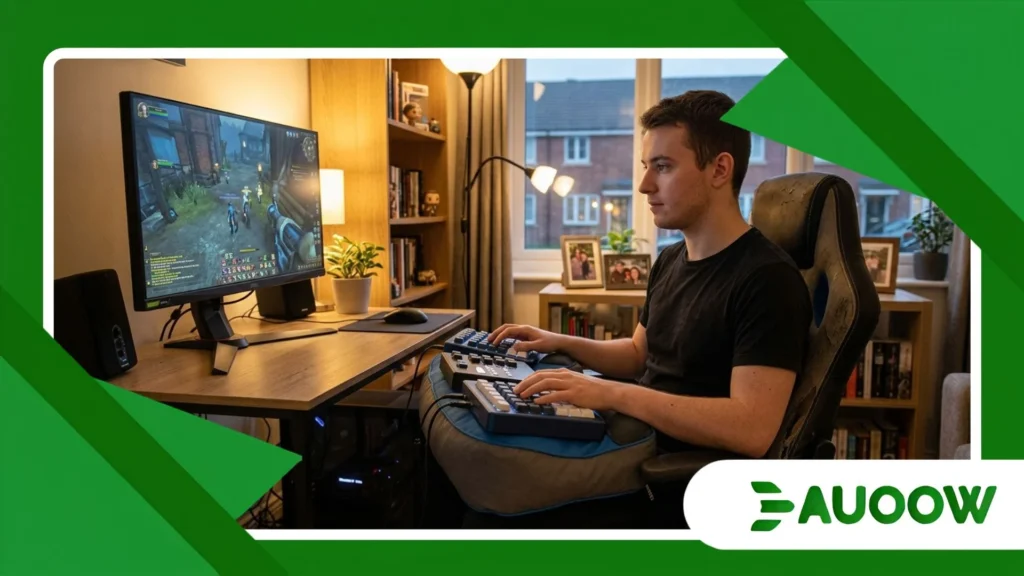
In a small suburban apartment outside Manchester, twenty-two-year-old Marcus sits before a glowing display.
His hands rest naturally on a split modular interface engineered to register the delicate touch of his knuckles.
Five years ago, a progressive muscular condition threatened his ability to navigate the digital spaces where his friends gathered every evening.
Today, using an array of soft-touch switches anchored to a beanbag mount on his lap, he commands a digital avatar with remarkable precision.
The room is quiet except for the subtle rhythmic click of custom microswitches a sound carrying social weight far beyond any digital milestone.
What This Analysis Explores
- The Shift from Niche Hacks to Mainstream Engineering: How dedicated hardware development moved out of garage workshops into corporate design labs.
- Structural Barriers in Digital Architecture: Why physical access alone does not guarantee meaningful digital inclusion.
- Legal and Social Milestones: The historical policies that pushed mainstream manufacturers to re-evaluate physical interface design.
- Comparative Ecosystem Hardware: A breakdown of modular systems, custom switches, and open-source software integration.
- The Unresolved Challenges Ahead: Economic accessibility, competitive regulation, and the threat of fast-moving tech obsolescence.
Why Did Standard Controllers Spend Decades Ignoring Human Diversity?
For nearly forty years, the video game industry operated under a rigid, unexamined assumption: every player possessed two fully functional hands, ten dexterous fingers, and the physical stamina to hold a two-pound plastic shell suspended in mid-air for hours.
The familiar gamepad featuring twin thumbsticks, a directional pad, four face buttons, and dual shoulder triggers became an unquestioned standard.
It was cost-effective to manufacture, easy to package, and calibrated for an idealized body profile that rarely represented the full diversity of players.
A structural detail often gets overlooked when examining this era of standardization. Early interactive media was constrained by memory limitations and processing speed,
which favored straightforward, uniform input mechanisms. But as software grew increasingly complex demanding simultaneous camera tracking, rapid combination inputs, and nuanced pressure sensitivity the physical controller evolved into a dense maze of inputs.
For players navigating cerebral palsy, spinal injuries, limb differences, or neuromuscular conditions, this design trajectory did not merely raise the difficulty curve; it constructed a physical barrier around digital play.
This historical oversight stemmed less from technical limitations and more from misaligned priorities.
Interactive entertainment was frequently categorized as a mere leisure item rather than a vital venue for contemporary culture, social connection, and creative expression.
When digital platforms are treated as toys rather than shared public spaces, accessibility features are routinely marginalized as costly additions or retrofits rather than core design requirements.
++ Adaptive Driving Technologies Worth Watching
How Did Community Hacks Force Mainstream Hardware Adaptations?
Long before major technology corporations paid attention to inclusive input options, the movement toward accessible design was sustained by independent engineers, occupational therapists, and disabled players themselves.
In small workshops and home labs, grassroots developers soldered custom wiring into commercial gamepads, repurposing industrial foot pedals, breath-operated sip-and-puff systems, and arcade joysticks to bypass standard inputs.
These early modifications reflected immense personal ingenuity, yet they remained fragile, complex, and expensive.
Bespoke setups often cost thousands of dollars, demanded specialized technical maintenance, and risked complete incompatibility whenever console manufacturers pushed software updates that rendered non-standard USB peripherals unrecognized.
What often gets missed in conversations about assistive tech history is the moment the industry realized accessibility was not a charitable niche, but a compelling domain of hardware engineering.
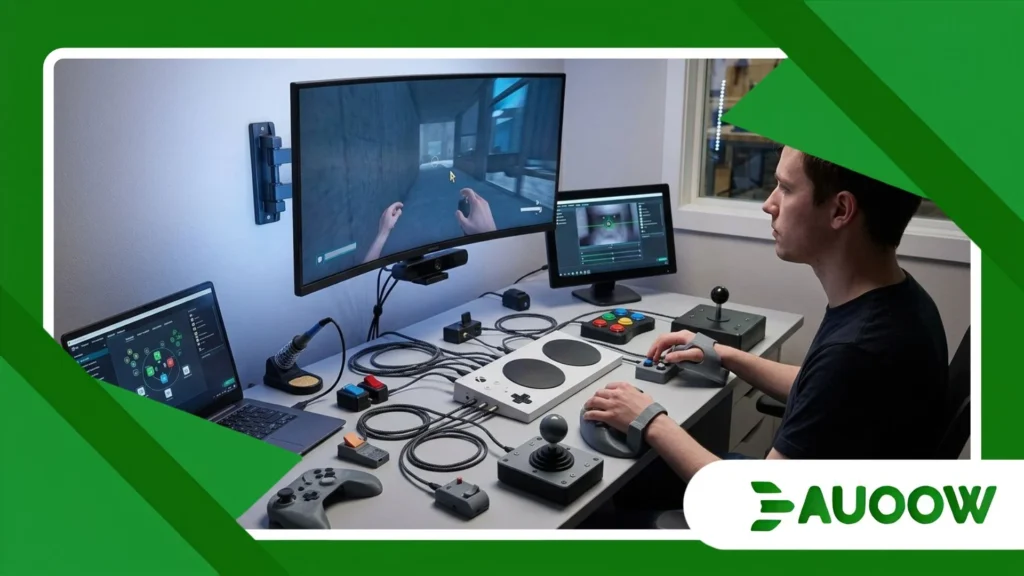
The turning point arrived when hardware designers moved away from creating a single “universal” accessible controller, focusing instead on modular hubs central devices acting as translation engines for a wide array of external switches, buttons, and joysticks.
By adopting the standard 3.5mm jack as a universal input port, manufacturers allowed users to connect whichever switch suited their specific mobility, whether operated by a chin, an elbow, or a foot.
As innovations in adaptive gaming controllers matured, physical design transitioned from static shells toward flexible ecosystems.
This modular evolution demonstrated that effective universal design does not require building one single tool for everyone; it means establishing a sturdy, adaptable foundation that each person can tailor to their own needs.
Are Historical Disability Rights Frameworks Shaping Today’s Digital Spaces?
It is tempting to view recent hardware accessibility as a modern corporate breakthrough driven strictly by market demand.
However, looking closer reveals a familiar pattern: structural progress in consumer technology almost always connects back to legal advocacy and public policy shifts established over decades.
The core principles governing modern device accessibility were established long before contemporary digital consoles existed.
Landmark civil rights policies like the Americans with Disabilities Act (ADA) of 1990 and Section 508 of the Rehabilitation Act initially addressed physical infrastructure focusing on wheelchair ramps, braille signage, and accessible public transit signals.
Yet, as social life, commerce, and recreation moved onto digital platforms, the understanding of what constitutes an “accessible environment” naturally expanded.
When public policy frameworks began mandating accessible telecommunications equipment and web interfaces, hardware manufacturers realized consumer entertainment devices would eventually meet similar legal expectations and community standards.
The emergence of global accessibility guidelines encouraged design teams to embed custom button remapping, sensitivity adjustments, and multi-device pairing directly into system operating software.
Early campaigns by disability rights advocates decades ago laid the groundwork for the flexible input settings configured on high-performance platforms today.
Also read: Why facial recognition accessibility raises daily access concerns
How Does Adaptive Input Technology Function in Practice?
To understand how these modular systems operate beyond technical spec sheets, consider the daily setup of Elena, a graphic designer who experienced changes in her right-hand mobility following a stroke.
Before modern adaptive hardware became widely available, re-engaging with digital environments required relying on complex third-party translation software that frequently desynchronized during system updates.
Today, Elena utilizes a low-profile adaptive hub resting flat on her desk, paired with three light-touch external switches mounted directly to her wheelchair armrest alongside an ultra-lightweight thumbstick guided by her left palm.
Through native device menus, she configures distinct input profiles tailored to different software applications.
Switching from a turn-based strategy game to a fast-paced narrative title requires selecting a single profile option to reassign every control layer instantly.
The interface does not require her body to adapt to the hardware shell; the setup adjusts directly to her natural range of motion.
This practical flexibility highlights how modern innovations in adaptive gaming controllers have helped transform accessible design from a collection of awkward workarounds into a refined, high-performance experience.
Read more: The rise of smart crosswalk accessibility in urban mobility plans
What Remaining Barriers Still Limit Full Universal Inclusion?
Despite substantial technological milestones, persistent structural hurdles prevent adaptive devices from reaching every person who could benefit from them.
A comprehensive view of the landscape shows that technical capability is only one component; economic distribution and manufacturing models strongly influence real-world access.
First, the cost of specialized assistive hardware remains a major obstacle for many households.
While base adaptive hubs produced by primary manufacturers are priced comparably to standard gamepads, specialized external switches such as mouth-operated pressure tubes, proximity sensors, or heavy-duty industrial foot pedals regularly command high individual prices.
Assembling a fully personalized, multi-switch setup can easily exceed the cost of the underlying digital platform itself.
Second, competitive online environments present distinct regulatory and design challenges. Automated moderation tools and anti-cheat algorithms often monitor for non-standard input patterns or rapid signal remapping.
Disabled players utilizing specialized macros or custom input layers to compensate for limited fine motor control can inadvertently trigger automated flags or system restrictions.
Finally, rapid product hardware cycles create ongoing uncertainty.
When new hardware generations or proprietary wireless standards are introduced, legacy adaptive equipment can lose native support, requiring users to source and fund updated hardware configurations from scratch.
Comparing Adaptive Hardware Implementations Across Key Criteria
| Hardware Category | Core Mechanism | Primary Target Audience | Key Strengths | Main Limitations |
| First-Party Modular Hubs | Central base unit with 3.5mm input ports & large touch pads | Players with varied mobility, grip limitations, or single-hand use | Native OS integration, accessible base pricing, plug-and-play simplicity | Requires purchase of external third-party switches for complex layouts |
| Open-Source 3D-Printed Rigs | Custom mechanical linkages mounted onto standard pads | Gamers with specific structural limb differences or budget constraints | High customization, low material cost, active community support | Requires technical assembly, lacks official manufacturer warranty |
| Sip-and-Puff Systems | Pneumatic pressure sensors driven by oral airflow | Individuals with high-level spinal cord injuries or quadriparesis | Allows full control without hand/foot movement, highly precise | High initial investment, requires regular hygienic maintenance |
| Biometric & Eye-Tracking Interfaces | Infrared camera tracking paired with muscular contact sensors | Users with severe neurodegenerative conditions (e.g., ALS) | Enables interaction without physical force or button actuation | High computational overhead, sensitive to ambient lighting changes |
Sustaining the Momentum of Inclusive Physical Design
The meaningful influence of modern innovations in adaptive gaming controllers extends well beyond recreation or digital entertainment.
When physical barriers to digital spaces are removed, we uphold everyone’s equal right to participate in modern social life, digital storytelling, and global online communities.
A thoughtful review of digital inclusion reminds us that accessibility cannot be treated as a finished milestone or a static feature list.
It represents an ongoing engineering commitment that thrives on active collaboration between hardware designers, software developers, public policy experts, and disabled community members.
Sustainable progress occurs when universal design principles are integrated into the earliest stages of hardware research and product design, rather than appended as an afterthought.
As virtual platforms become increasingly integral to professional collaboration, remote education, personal development, and creative expression, the technical insights gained from adaptive input hardware will continue to inform how humans interact with technology across every domain.
Building devices that welcome diverse human movement ensuring that physical differences do not dictate access is fundamentally good engineering, serving as a meaningful reflection of an open, inclusive society.
Frequently Asked Questions
Are adaptive controllers compatible across different gaming consoles and PCs?
Compatibility varies based on the specific hardware hub and platform ecosystem.
Most first-party adaptive hubs feature native support for their respective primary platforms and personal computers.
For cross-platform connectivity across non-native hardware, players frequently use specialized third-party adapters or open-source input bridges, although universal cross-compatibility across all devices remains an ongoing industry objective.
Can custom adaptive switches be used for non-gaming software applications?
Yes. Many adaptive hubs connect to standard operating systems as standard Human Interface Devices (HID).
This universal connectivity allows external buttons, foot switches, and joysticks to be assigned to standard keyboard shortcuts, cursor movements, and custom commands within productivity software, web browsers, digital creative tools, and assistive communication programs.
How do insurance providers or assistive technology grants handle adaptive gaming equipment?
In many regions, public healthcare systems and private insurance carriers have historically categorized gaming hardware as non-essential recreational equipment, making direct reimbursement uncommon.
However, as medical professionals increasingly recognize interactive media as a helpful component in physical rehabilitation, fine motor maintenance, and social wellness, specialized non-profit foundations, vocational rehabilitation programs, and assistive technology grants frequently step in to provide hardware funding or equipment loans.
What is the difference between button remapping and macro scripting in adaptive gaming?
Button remapping directly swaps the function of one physical input to another, such as reassigning a shoulder button trigger to a foot-operated switch.
Macro scripting allows a single physical press to trigger a sequence of multiple digital actions automatically.
While basic input remapping is universally supported across most modern platform settings, macro scripting requires careful configuration to maintain full compliance with competitive online guidelines.
