
Why disability inclusion gets lost in school policy language
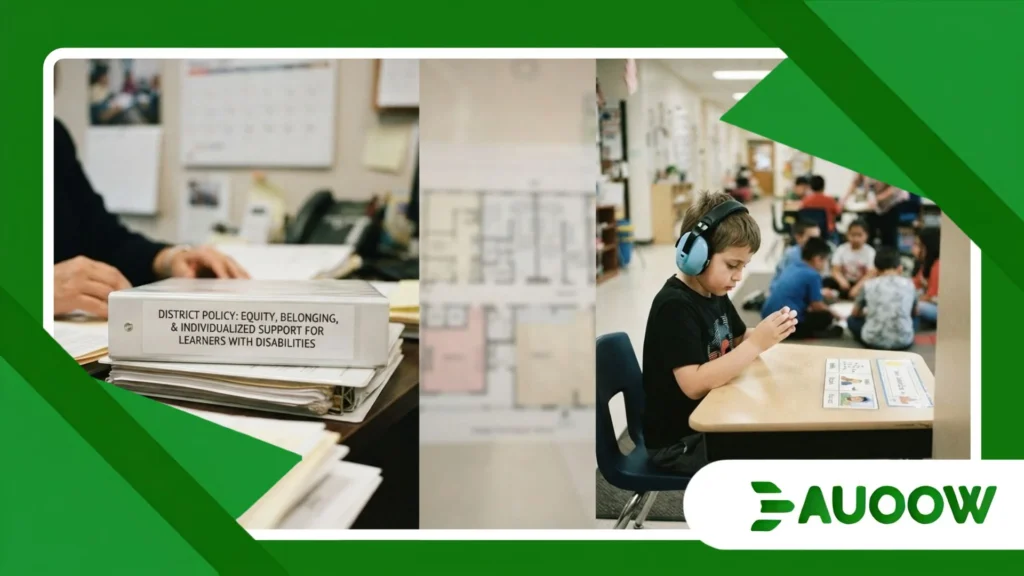
The binder sits on the principal’s desk with a neat label on the spine, heavy enough to hold a brick.
Inside sit forty-two pages of carefully drafted commitments about equity, belonging, and individualized support for learners with disabilities.
Three hallways down, an eight-year-old boy with autism spends his third consecutive afternoon sitting at a side table because the noise-canceling headphones listed on his plan were never ordered, and the transition routine between math and recess changed without warning.
Nobody in that building wakes up wanting to fail a child.
Even so, disability inclusion gets lost in school policy language frequently when well-meaning words on paper meet rushed routines, tight budgets, and loose phrasing.
This article examines how that gap opens and widens inside public schools.
We trace the background behind disability mandates in schooling, see how bureaucratic drafting can soften real obligations into polite aspirations, look at what unfolds in classrooms and homes when wording stays blurry, and explore practical changes that help policies work in everyday routines.
How Did Good Intentions Turn Into Vague Promises?

Walk into many district board meetings and you hear phrases like “access for all,” “least restrictive environment,” and “culturally responsive support.”
Those expressions sound reassuring and signal care, yet they often leave daily routines undefined.
Friction begins when aspirational phrasing takes the place of concrete steps.
A policy might state that schools will “strive to provide appropriate accommodations” or “encourage participation in general education settings whenever feasible.”
Words such as strive, encourage, and whenever feasible can leave wide exits open when schedules tighten or staffing runs short.
A quiet tension also shapes how districts write manuals.
Legal compliance teams draft rules to reduce institutional exposure, whereas educators need clear actions they can carry out at 8:15 a.m. on a busy morning.
When one document tries to satisfy both legal caution and classroom clarity, plain direction often gives way to hedging.
Why Do Buzzwords Replace Measurable Commitments?
Buzzwords move quickly through education circles. Within two or three budget cycles, expressions like “universal design” or “neurodiversity affirmation” shift from research discussions into district handbooks.
Adopting new terms can create a sense of movement before daily practices change. A board updates a policy manual, shares an announcement, and treats the text as progress.
Meanwhile, a student using an augmentative communication device can still wait months for a classroom tablet to arrive with the right communication software configured and tested.
Families often carry a heavy share of that gap behind the scenes.
Parents sitting across a conference table should not need legal training or a glossary of policy jargon just to find out whether their child will have trained support during lunch and assemblies.
++ Making Online Assessments More Inclusive
Where Does Today’s Policy Gap Come From?
Understanding why disability inclusion gets lost in school policy language becomes clearer when we look back at how disability rights entered public education.
In the United States, federal measures such as Section 504 of the Rehabilitation Act of 1973 and the Education for All Handicapped Children Act of 1975 later renamed the Individuals with Disabilities Education Act (IDEA) marked major turning points.
Before those laws, large numbers of children with disabilities were routinely left out of public schools or placed in separate settings with minimal instruction.
Those statutes established substantive protections, including free appropriate public education, procedural safeguards, and individualized plans.
Over time, however, the administrative machinery built around those protections grew complex as state rules, local procedures, and compliance forms layered onto the original mandate.
The pattern shifts shape across periods rather than disappearing. Earlier exclusion often looked like closed doors and outright refusals.
Later barriers frequently look quieter: a policy that affirms inclusion on paper while funding separate pull-out rooms in practice, or a district rule that leaves “reasonable support” unspecified at the school level.
++ How Student Voices Are Shaping Inclusive Education Policies
What Quietly Changed Inside Schools Over Time?
Over the past twenty years, daily school life has shifted in noticeable ways.
Digital learning tools, standardized testing pressures, larger classes, and ongoing shortages of special educators and paraprofessionals have reshaped what happens in classrooms.
Many policies still reflect older routines or assume staffing levels that do not match current conditions.
A rule calling for co-teaching or real-time captioning can read cleanly on a policy page yet stall when one educator covers two groups because a position sits open.
Accountability systems rarely capture how a policy feels to the student living inside it.
Districts commonly monitor attendance, test outcomes, and completed forms, while paying far less attention to whether a student with low vision can read a digital worksheet projected at the front of the room before the bell rings.
Also read: The Growing Role of Universal Design for Learning in Modern Schools
What Happens When Policy Words Meet Daily School Life?
Picture a middle school student who uses a wheelchair and experiences mild cerebral palsy.
Her individualized plan states she should have “full access to school activities and peer interaction,” a phrase that reads neatly in a file.
Then comes a spring field trip to a historic science center.
The charter bus arranged by the school lacks a lift, the museum’s upper gallery is reached only by a narrow spiral staircase, and no alternative plan was set up ahead of time.
Her parents receive a call two days before the trip suggesting she stay back with another grade level so she “won’t feel left out.”
Situations like this unfold without ill will. A coordinator books a familiar bus company, a brochure makes the venue look appealing, and a broad promise of “full access” arrives without a practical checklist attached.
Who Bears the Cost of Ambiguous Rules?
When rules remain vague, the weight rarely falls on the people drafting the text.
It lands on families who must track details, send reminders, and advocate repeatedly just to keep basic supports operating.
It also lands on classroom teachers who want every learner included yet lack practical training or shared planning time.
A general education teacher welcoming a student with dyslexia and anxiety without hands-on guidance or backup can feel left to improvise alone rather than supported to succeed.
Ambiguous wording strains relationships across the whole school community.
Educators can lose confidence, families can lose trust, and students may pick up the quiet message that belonging requires constant negotiation.
| Policy Phrasing Style | How It Reads on Paper | Likely Classroom Reality | Impact on Students & Families |
| Aspirational & Vague | “Staff will make best efforts to support inclusion whenever possible.” | Follow-through often depends on individual comfort, mood, or spare time. | Uneven access; families must repeatedly chase updates and reminders. |
| Unfunded Mandate | “All digital curriculum materials must be accessible to every learner.” | Unvetted apps or uncaptioned videos still get assigned mid-semester. | Students with sensory or cognitive disabilities hit avoidable barriers. |
| Procedural & Rigid | “Accommodations require formal documentation reviewed by committee.” | Immediate classroom adjustments wait weeks for administrative review cycles. | Daily learning stalls while waiting on formal sign-offs. |
| Specific & Actionable | “Provide accessible digital files 48 hours prior; assign named staff lead.” | Clearer ownership, predictable preparation, and faster troubleshooting. | Higher participation, less friction, and steadier trust at home. |
How Can Schools Turn Paper Commitments Into Real Inclusion?
Rewriting policy language is an early step, and often not the hardest one.
Lasting change depends on pairing plain, clear wording with named responsibility, realistic timelines, and honest planning around time and resources.
Instead of writing that a school will “offer support as needed,” strong policy states what support is provided, who coordinates it, when it starts, and how families hear if plans shift.
Clear language cuts down on guesswork so fewer students slip through the cracks between meetings.
Policies drafted far from daily classrooms also miss blind spots that front-line experience catches right away.
Involving educators, disabled students, and families from the start brings real barriers to light early a student who uses a screen reader or experiences sensory overload can spot a flaw in a plan quickly that a committee might overlook for months.
Regular review matters just as much. A policy is not carved in stone; it works best as a living agreement that gets checked, questioned, and adjusted openly so disability inclusion gets lost in school policy language does not become an accepted routine.
Building Schools Where Words Match Daily Practice
Real inclusion grows out of steady, ordinary habits rather than broad slogans on a wall.
It shows up when a syllabus goes out in an accessible format before day one, when a substitute educator receives clear notes on a student’s communication preferences before the morning bell, and when school budgets treat accessibility as core infrastructure rather than an afterthought.
Bridging the gap between written policy and daily school life takes patience, humility, and candid follow-through across leaders, staff, and families.
Schools rarely need more elaborate wording; they need practical commitments backed by real time, training, and listening when a plan falls short in practice.
When disability inclusion gets lost in school policy language is replaced by clear expectations and shared accountability in every hallway and classroom, belonging becomes part of everyday school life rather than a promise left inside a binder.
Frequently Asked Questions
Why do school policies often sound supportive yet fail in practice?
Many policies rely on flexible wording such as “when appropriate” or “as resources allow” that sounds welcoming but leaves out concrete steps.
Without clear timelines, named leads, and practical training, busy schools often fall back on familiar routines.
How can parents spot vague language in a school or district policy?
Look for terms that leave follow-through optional, such as encourage, strive, consider, or endeavor, without stating who acts or by when.
Asking “Who does this, and how will we know it happened?” often reveals where wording is too loose.
Does clearer policy language mean extra work for teachers?
Clear policies frequently reduce confusion rather than add busywork.
When expectations, roles, and accessible materials are prepared ahead of time, teachers spend less time improvising under pressure or tracking down missing tools mid-lesson.
What role does assistive technology play in school inclusion policies?
Assistive technology including text-to-speech tools, captions, alternative keyboards, and communication boards helps most when devices stay maintained, work with school software, and arrive on time.
Effective policies cover setup, updates, and technical support, not only purchasing requests.
