
Why Local Governments Play a Critical Role in Accessibility
When Arthur, a retired civil servant, wheels himself down his town’s main street on a Tuesday morning, his biggest challenge is not his mobility device. It is the municipal curb that ends abruptly in a six-inch concrete drop.
Local governments play a critical role in accessibility long before national laws or international treaties shape daily life, because inclusion happens on neighborhood pavement, in public libraries, and at local bus stops.
Turning his chair around to navigate oncoming traffic for three blocks just to find a usable driveway cut shows how everyday municipal decisions dictate who participates in community life and who remains isolated at home.
In This Article
- The Pavement Paradox: Why national statutes depend on municipal enforcement.
- Structural Inertia: How local planning decisions perpetuate historic physical barriers.
- The Human Cost of Bureaucratic Silos: The gap between public transit, zoning, and social housing.
- Policy to Pavement: A detailed evaluation of local civic intervention models.
- Editorial FAQ: Everyday questions on local civic responsibilities and community rights.
Why does local municipal action determine daily freedom?
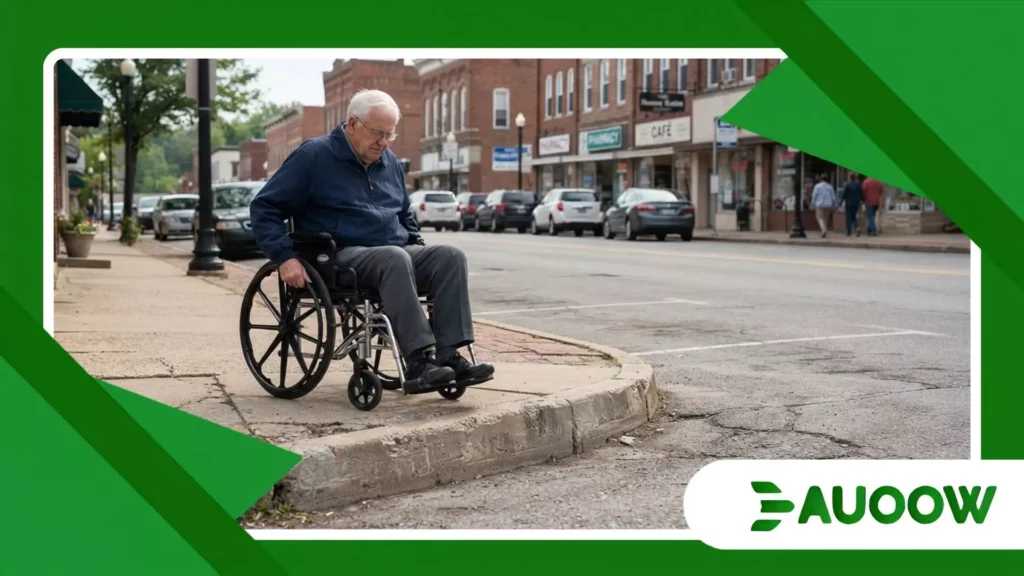
National legislation sets fundamental rights, but local councils decide where public funds go each fiscal quarter.
Broad statutes can mandate equal access for disabled residents, but they cannot pour concrete for a compliant ramp or repair a broken elevator at a suburban transit hub.
Understanding how local decisions shape freedom requires looking at immediate points of contact between residents and their surroundings.
When a city council approves a downtown redevelopment plan without incorporating Universal Design principles, it restricts access to public life and commerce for wheelchair users and visually impaired residents for years to come.
This localized decision-making often leads to uneven conditions within the same municipality.
Crossing a street boundary into an adjacent neighborhood can mean moving from tactile paving and accessible pedestrian signals to cracked asphalt and dark intersections.
There is also a regulatory aspect that warrants attention: municipal bodies hold direct authority over private commercial developments through building permits and code inspections.
When local inspectors sign off on non-compliant entryways during construction, physical barriers become built into the local economy.
++ How People with Disabilities Are Using Smart Glasses in Daily Life
How do historical zoning decisions impact accessibility today?
To understand current urban barriers, it helps to look at how twentieth-century planning separated residential, commercial, and industrial zones.
Many towns were built around private car ownership, working on the assumption that every resident could drive, negotiate stairs, or walk long distances.
This pattern appears across various public infrastructure projects.
Older urban centers frequently prioritized architectural preservation over ease of movement, while newer developments focused on traffic throughput rather than pedestrian connections.
The accessibility challenges facing many mid-sized cities stem directly from choices made by planning commissions decades ago.
Retrofitting existing environments requires significantly more resources and effort than integrating access into original architectural plans.
Also read: Why facial recognition accessibility raises daily access concerns
What happens when municipal enforcement fails?
Consider a professional who uses a power wheelchair and accepts a position in a downtown office.
On paper, the workplace meets standard access requirements.
In practice, the local transit agency operates lift-equipped vehicles on only a portion of its routes due to maintenance delays.
Getting to work becomes an unreliable process, dependent on whether the arriving bus features a working ramp.
Why do municipal silos prevent holistic accessibility?
In many civic administrations, transit departments function separately from public works, while housing offices manage their projects independently.
This administrative divide leads to gaps in public infrastructure.
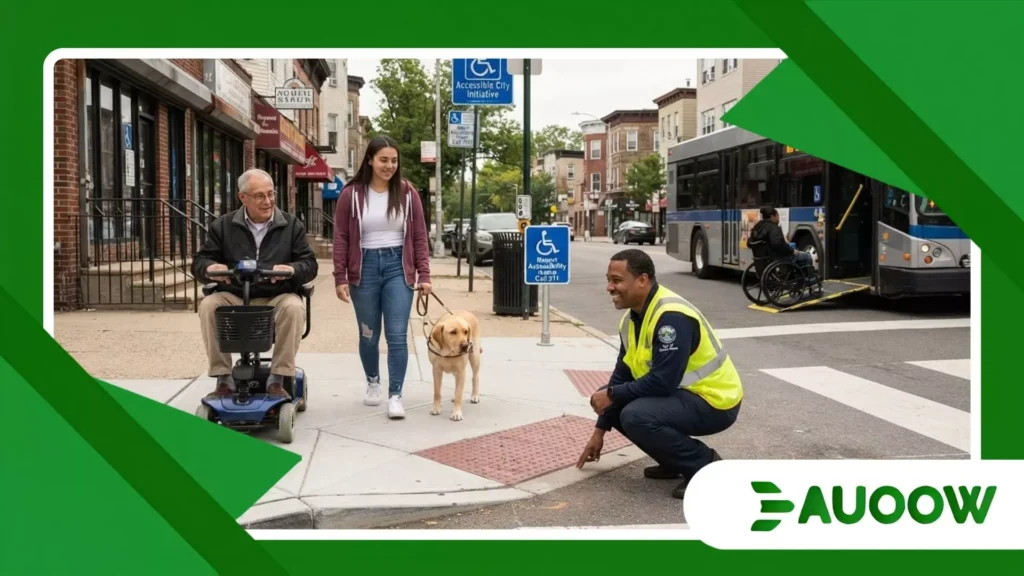
A city might introduce low-floor buses while public works leaves stops without raised boarding areas, making vehicle ramps less effective.
Similarly, a housing authority might fund accessible apartments while zoning boards permit nearby shopping areas to remain difficult to navigate with mobility devices.
Local authorities are positioned to address these disconnects.
Because municipal leaders work directly within the communities they serve, they can observe how public works, housing, and transit systems interact in real time.
When local administrative teams establish joint working groups, public investments align more effectively, creating continuous paths through the community.
Read more: The rise of smart crosswalk accessibility in urban mobility plans
How can local policy models drive concrete change?
Different municipal structures produce varied outcomes for residents with physical, sensory, or cognitive disabilities.
The following comparative table illustrates how varying approaches to local governance impact daily civic life:
| Governance Dimension | Reactive Compliance Model | Fragmented Municipal Model | Integrated Universal Design Model |
| Primary Driver | Responding to lawsuits or complaints | Isolated departmental initiatives | Proactive local policy and urban design |
| Infrastructure Focus | Minimum legal compliance (e.g., basic ramps) | Ad-hoc updates during major repairs | Continuous, city-wide tactile & mobility paths |
| Community Input | Formal public hearings after planning | Intermittent advisory committees | Direct co-design with disability advocacy groups |
| Public Transit | Partial fleet accessibility | Accessible vehicles with broken stop infrastructure | Fully integrated low-floor fleets & accessible stops |
| Economic Impact | High retrofit costs; frequent litigation | Uneven economic inclusion across zones | Enhanced workforce participation & local commerce |
Moving from reactive compliance toward an integrated approach requires administrative commitment that treats physical access as essential municipal infrastructure rather than a secondary consideration.
When local councils approach accessibility with the same attention given to water utilities or road maintenance, public resources are used far more effectively.
What role does community co-design play in city management?
Effective municipal initiatives often share a key element: involving disabled residents directly in planning public projects.
When city teams invite wheelchair users, blind commuters, and neurodivergent advocates to evaluate proposed street designs, park updates, and public web platforms before implementation, design issues can be addressed before construction begins.
Co-design enables residents to contribute directly to shaping the physical environment of their towns and cities.
How do municipal digital portals affect daily inclusion?
Accessibility applies to digital spaces as well as physical streets. Local administrations rely on online systems for property taxes, school registrations, utility services, and public safety updates.
When a municipal portal does not align with Web Content Accessibility Guidelines (WCAG), visually impaired residents encounter unnecessary barriers when trying to pay taxes or access public information independently.
As public services move online, local authorities need to maintain screen reader support, clear typography, and straightforward navigation.
Digital barriers on public sites limit resident participation just as physical steps do at a city hall entrance.
Smart city tools require thorough evaluation for screen reader compatibility and clear usability. Cities function best when their digital tools and physical spaces remain usable for all residents.
Building Cities That Work for Everyone
Designing local spaces around Universal Design creates environments that serve the broader public.
Curb ramps assist parents pushing strollers, delivery personnel moving cargo, and travelers with luggage.
Removing physical and administrative barriers creates more adaptable, functional spaces for the entire community.
When local leadership prioritizes open, well-planned infrastructure, public spaces become safer and more welcoming for everyone who uses them.
Editorial FAQ
Why are local municipal building codes often more important than national accessibility laws?
National laws establish broad rights and standards, but local building codes and municipal inspections govern practical construction, permitting, and daily oversight.
Local inspectors verify whether entrances, door widths, and restrooms are functional before spaces open to the public.
How can local governments ensure public transit is fully accessible?
Local authorities improve transit access by coordinating vehicle purchases with street improvements.
This includes introducing low-floor buses, adjusting platform heights, maintaining elevator systems, providing clear audio-visual announcements, and installing tactile surfaces at stops.
What can citizens do if their local government neglects sidewalk accessibility?
Residents can document damaged or non-compliant infrastructure and submit reports through local public works service lines.
Participating in council meetings, joining local accessibility advisory committees, or contacting local representatives helps bring attention to structural barriers.
How does web accessibility fall under the responsibility of local municipal governments?
Local governments are responsible for making public services and information reachable for all residents.
Following updated Web Content Accessibility Guidelines (WCAG) helps ensure municipal websites, digital payment portals, and emergency alerts work with screen readers, keyboard navigation, and high-contrast displays.
