
Biometric Data in Assistive Tech: Innovation or Overreach?
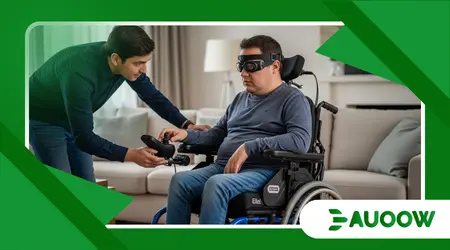
The ethical debate surrounding Biometric Data in Assistive Tech began for me not in a boardroom, but in a small apartment in Lyon.
I was watching a friend named Elias interact with his wheelchair. Elias lives with a high-level spinal cord injury, and his new chair utilizes eye-tracking and facial micro-gesture recognition to navigate.
To the casual observer, it looks like a miracle of independence.
But as Elias calibrated the sensors, he made a joke that has stayed with me: “My chair knows more about my stress levels than my therapist does.”
He wasn’t entirely wrong. The infrared cameras were mapping the unique geometry of his irises and the heat signatures of his skin.
This wasn’t just a tool anymore; it was a data harvester. This moment captures the friction at the heart of 2026: the line where a life-changing convenience blurs into a state of permanent surveillance.
The Silent Trade-off in the Digital Age
- The Miracle of Intent: How sensors interpret the body to bypass physical barriers.
- The Invisible Harvest: The types of biological information being stored in the cloud.
- Legislative Lag: Why privacy laws are still playing catch-up with our hardware.
- The Autonomy Paradox: Gaining movement at the potential cost of privacy.
Why are we seeing a surge in biological sensors?
The integration of Biometric Data in Assistive Tech is driven by a genuine desire to solve complex interface problems.
For decades, the primary bottleneck of accessibility was the physical switch the joystick, the button, or the puff-tube.
These require a level of motor control that many people do not have.
By shifting the interface to the biological level tracking brain waves (EEG), muscle electrical activity (EMG), or eye movement developers have effectively removed the middleman.
What rarely enters this debate is the fact that these sensors are becoming increasingly sensitive. We are no longer just talking about “up, down, left, right.”
Modern assistive devices can detect heart rate variability, pupil dilation, and even the subtle tremors that may precede a neurological flare-up.
There is a detail that cost-benefit analyses often ignore: this data is incredibly valuable to third parties.
When a person’s mobility is tethered to a device that “reads” them, they are in a vulnerable position where opting out of data collection might feel like opting out of movement itself.
++ Assistive Technology and Data Extraction: Who Owns Accessibility Data?
How does the history of medical records shape our current fears?
Historically, medical data was locked in a physical filing cabinet, protected by strict ethical oaths and heavy padlocks.
As we transitioned to the digital era, that data migrated to servers. In my reading of this scenario, the transition was quiet but transformative.
Assistive technology used to be “dumb” hardware a prosthetic limb was primarily a piece of carbon fiber and hydraulics. Today, it is an IoT (Internet of Things) device.
There is a structural detail that often goes unnoticed: the shift from “medical device” to “consumer electronic.”
When a prosthetic hand uses AI to recognize patterns in muscle movement, it often falls under a different set of privacy regulations than a hospital heart monitor.
This regulatory gray area is where many companies operate. We prioritize the innovation while potentially leaving the door open for data brokers to monetize the biological essence of the user.
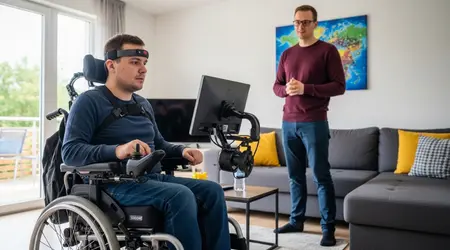
Is there an “Accommodation Tax” on our privacy?
Imagine a student with a non-verbal learning disability using an AI-powered communication tablet.
To function effectively, the tablet’s camera monitors her facial expressions to help predict the words she wants to say.
This use of Biometric Data in Assistive Tech allows her to participate in seminars with unprecedented speed.
However, that same tablet is recording her emotional reactions to every lecture and social interaction.
The analysis most honest about our current trajectory suggests that people with disabilities are often the first to experience these forms of privacy invasion.
Because the need for the technology is so high, the bar for “informed consent” is often lowered.
If the choice is between having a voice in a classroom and keeping your facial data private, most will choose the voice.
There is something unsettling about a world where the price of inclusion might be the surrender of one’s biological anonymity.
Who really owns the data generated by a bionic limb?
There is a proprietary nature to this software that is often ignored. Most high-tech assistive devices are not “owned” in the traditional sense; they are licensed.
The software that interprets your brain waves to move a cursor belongs to a corporation.
This creates a strange form of enclosure where your own biological signals are being “translated” by a company that reserves the right to store that translation on its own servers.
We need to ask what happens when these companies are sold.
If a company that manages the neural interfaces for individuals who are blind is acquired by a massive social media conglomerate, does that biological data become an asset in a new advertising profile?
The lack of “Data Sovereignty” for users is a looming crisis that the industry is hesitant to discuss in its promotional materials.
Also read: Wearable Health Monitors for Chronic Conditions
What actually changed after the 2025 Privacy Accords?
The landscape isn’t entirely bleak. Last year’s shifts in international data policy began to recognize “Biological Privacy” as a distinct human right.
This was a direct result of advocacy from groups who realized that Biometric Data in Assistive Tech was being treated as a “free resource” for AI training.
Post-2025 Standardized Protections
| Feature | Pre-2025 Standard | Post-2025 Regulation |
| Data Ownership | Often held by the manufacturer. | Legally resides with the individual. |
| Consent | “All or nothing” terms of service. | Granular “Opt-in” for specific signals. |
| Storage | Indefinite cloud storage. | Mandatory local processing for vitals. |
| Third-Party Access | Permitted for “product improvement.” | Strictly prohibited without medical necessity. |
| Right to Delete | Difficult for neural maps. | Standardized “Right to Forget” for profiles. |
Can “Edge Computing” save us from overreach?
There is a technical solution gaining ground: Edge Computing. This refers to a system where data is processed locally on the device itself, rather than being sent to a central server.
If Elias’s wheelchair can recognize his facial gestures without ever uploading his face to the cloud, the privacy risk drops significantly.
However, we should question why this isn’t already the industry standard. Processing data locally requires more expensive chips and more efficient batteries.
For many manufacturers, it is cheaper to use the user’s data to “train” their central algorithms. We are witnessing a classic battle between corporate efficiency and individual liberty.
Read more: Metaverse Accessibility: Opportunities and Risks in Virtual Worlds
How do we balance safety with the right to be “untracked”?
In the realm of care for seniors or those with cognitive disabilities, the argument for surveillance is often framed as “safety.”
GPS trackers and fall-detection sensors can save lives. However, the person being “protected” is often the one with the least say in how their data is used.
If a smart home is constantly monitoring movements to “prevent accidents,” does that person still have a private life?
When every trip to the bathroom or restless night of sleep is logged as a data point, the home stops being a sanctuary and starts being a laboratory.
The challenge for 2026 is creating systems that offer a “Safety Net” without turning into a “Spider Web.”
Why is “Neural Privacy” the next great frontier?
We are entering the era of Brain-Computer Interfaces (BCI). For people with locked-in syndrome, this is a profound development.
But the data involved here is the most intimate information imaginable: the very intentions of a human being.
We need “Neuro-Rights” a legal framework that prevents the commercialization of brain data.
Without it, we risk a future where our internal signals could be used to predict consumer preferences.
It sounds like science fiction, but for the developers currently working on these interfaces, it is simply the next set of data points to be optimized.
The Architecture of Ethical Autonomy
The evolution of accessibility is one of the most significant chapters of our modern age, but we must read the fine print.
As I watch Elias navigate the world with a flick of his eyes, I am reminded that his independence is a victory but it shouldn’t be a transaction.
The future of Biometric Data in Assistive Tech must be one where the technology serves the human, not the other way around.
The tools we build today will define the boundaries of freedom for decades to come.
We must ensure that the ramps we build into the digital world don’t lead straight into a room with no privacy.
True accessibility means having the same rights as everyone else including the right to move, speak, and live without being a permanent source of revenue for a tech giant.
Privacy and Assistive Technology
Is it possible to use high-tech assistive devices without sharing biometric data?
It depends on the manufacturer. Some modern devices now offer an “Offline Mode” or use “Edge Computing” to process data locally. However, many features like AI-driven predictions may still require a cloud connection.
What is the difference between “medical” and “consumer” biometric data?
Medical data is typically gathered in a clinical setting and is protected by laws like HIPAA or GDPR-Health.
Consumer biometric data, often found in wearables or apps, is frequently governed by standard “Terms of Service,” which provide fewer protections.
Can my employer access the biometric data from my work-provided assistive tech?
Under 2026 labor regulations in many regions, employers are prohibited from accessing raw biological data.
However, they may see usage statistics. It is vital to review your company’s “Reasonable Accommodation” agreement.
What should I look for in a privacy policy for a new assistive device?
Look for “Data Minimization,” “Local Processing,” and a clear “No Third-Party Sale” clause. If a policy is vague about where your neural or biological data goes, it is a significant red flag.
Are there laws specifically protecting “Neuro-Rights”?
As of 2026, several countries have begun incorporating “Neuro-Privacy” into their legal frameworks.
These laws aim to protect the “mental integrity” of individuals using brain-computer interfaces, ensuring that their thoughts cannot be sold or used without explicit consent.
