
How Sensory-Friendly Classrooms Improve Learning Outcomes
Sensory-friendly classrooms improve learning outcomes not by altering academic standards, but by fundamentally transforming how children experience the physical space where learning occurs.
Consider an eight-year-old named Leo sitting near a double-paned window on a typical Tuesday morning.
To an outside observer, the second-grade room is a model of contemporary primary education: bright fluorescent tubes humming overhead, colorful educational posters covering every square inch of drywall, and the rhythmic scraping of plastic chair legs against uncarpeted floorboards.
To Leo, however, this environment is a heavy burden on his nervous system. The high-frequency flicker of the lights creates a subtle, persistent micro-strain on his visual processing.
The acoustic clutter forces his brain to spend valuable cognitive bandwidth filtering out background noise rather than deciphering reading comprehension instructions.
By mid-morning, he is disengaged, frequently misdiagnosed as merely inattentive, and quietly falling behind his peers.
Key Takeaways from This Article
- Beyond Neurodivergence: Environmental modifications benefit neurotypical students alongside autistic and ADHD learners.
- Acoustics and Lighting Matter: Simple physical adjustments yield measurable gains in attention span and retention.
- Historical Context: Today’s spatial models evolve from early public health initiatives rather than modern design trends.
- Economic Viability: Low-cost structural adaptations produce long-term institutional returns without massive capital expenditure.
How Did School Architecture Become a Barrier to Cognitive Focus?
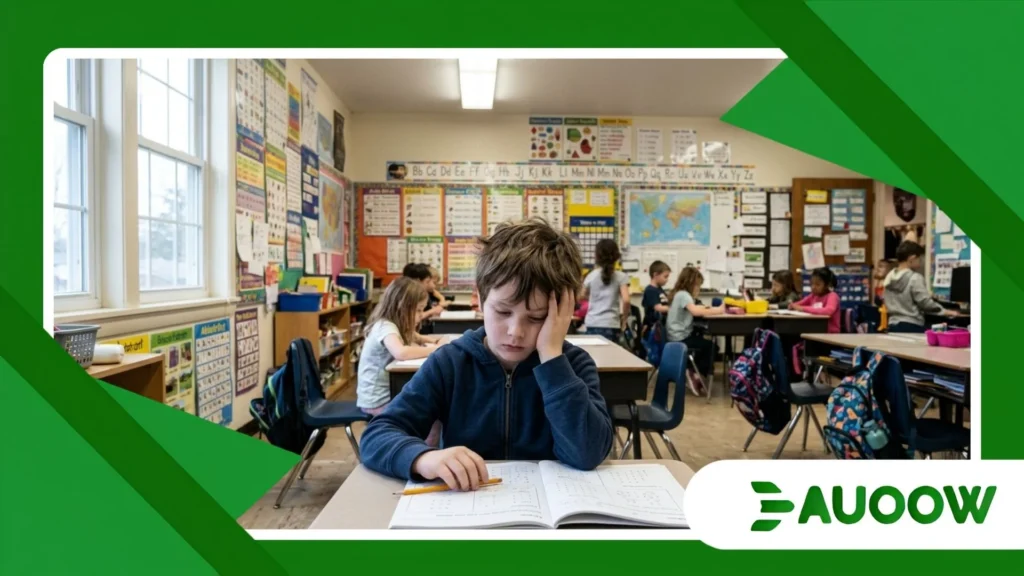
When we look back at the origins of western institutional design, modern school buildings were rarely planned around neurological diversity.
The standard classroom footprint was engineered during the industrial expansion of the early twentieth century, taking explicit design cues from factory floors and administrative pools.
The priority was clear: maximum occupancy, low-cost sanitation, standardized oversight, and high durability.
Hard, non-porous surfaces like polished terrazzo, vinyl tile, and cinderblock walls were chosen because they were easy to scrub down with harsh disinfectants during seasonal outbreaks of illness.
What went unexamined for decades was how these reflective materials bounce sound waves infinitely around a room.
High-contrast fluorescent lighting was introduced later to reduce energy bills, largely ignoring how visual flicker induces headaches and sensory fatigue.
The architecture was hygienic and scalable, but it was often sensory chaos.
When observing how sensory-friendly classrooms improve learning outcomes, it becomes obvious that we are gradually rethinking a century of industrial spatial design in favor of more human-centered environments.
What Structural Details Are Ignored in Standard Educational Spaces?
There is a structural detail that frequently goes unnoticed when district boards review academic failure rates: we tend to lean toward framing learning difficulties purely as pedagogical or motivational issues.
We scrutinize curricula, mandate standardized test prep, and purchase various digital applications. Yet, we rarely evaluate the ambient environment in which those tools are actually deployed.
When a student struggles to retain reading material, the immediate assumption is often a cognitive bottleneck or behavioral non-compliance. The physical room itself is treated as a neutral backdrop.
Careful analysis of contemporary spatial design suggests this neutral backdrop is an illusion. Air quality, reverberation time, visual clutter, and ergonomic seating directly alter autonomic nervous system responses.
When a child sits in a space that triggers a mild stress response, the prefrontal cortex the exact region responsible for working memory, analytical reasoning, and emotional regulation goes offline.
Designing intentional spaces where sensory-friendly classrooms improve learning outcomes requires recognizing that the physical environment is an active instructional variable, not merely a passive container.
++ How Student Voices Are Shaping Inclusive Education Policies
How Does Acoustic Engineering Influence Literacy and Retention?
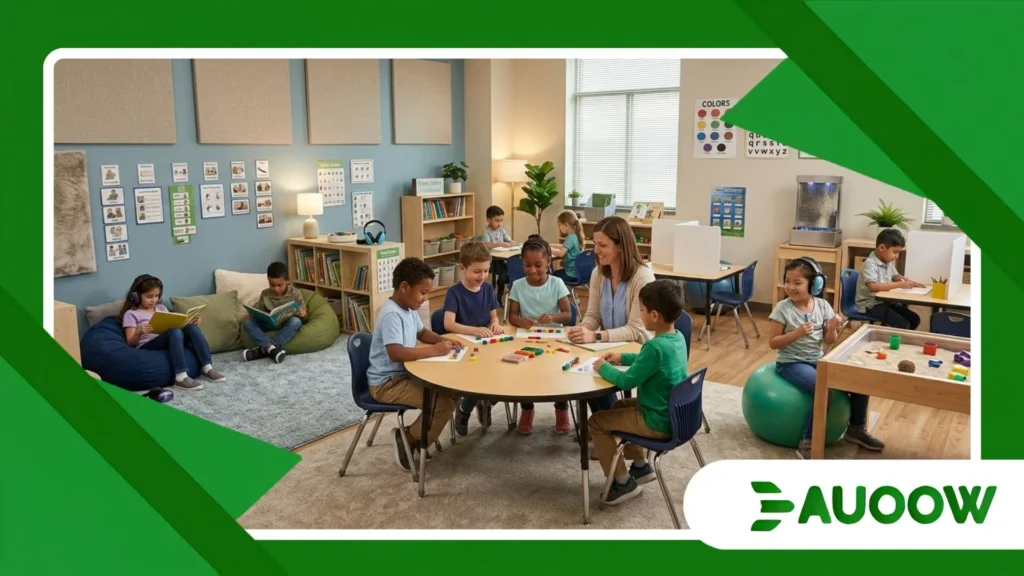
Noise levels in conventional classrooms frequently exceed recommended acoustic parameters for children whose central nervous systems are still developing.
Sound Processing in the Young Brain Children do not process auditory information the exact same way adults do.
An adult brain possesses the neurological maturity to filter out a humming air conditioner, street traffic, and hallway foot traffic while focusing primarily on a speaker’s voice.
The Cost of Auditory Strain A young brain often lacks advanced signal-to-noise filtering capability.
When background ambient noise rises, young learners can miss crucial phonemes the foundational building blocks of language comprehension and clear communication.
Simple Remediation Strategies Addressing acoustic challenges does not require millions in structural renovation.
Installing low-cost felt acoustic panels, placing rubber caps under desk legs, and strategically placing dense floor rugs dramatically lowers reverberation time.
These modest modifications allow teachers to speak at natural conversational tones, preventing vocal strain while giving students the acoustic clarity needed to retain complex instructions over long periods.
Also read: The Growing Role of Universal Design for Learning in Modern Schools
What Happens When Visual and Lighting Environments Are Calibrated?
Visual clutter and harsh illumination are twin stressors in the everyday educational experience.
The practice of covering classroom walls with educational posters, alphabet strips, and behavior charts often stems from good intentions. Teachers naturally want to create stimulating and engaging spaces for their students.
However, neurological research shows that excessive visual input creates cognitive competition. The brain struggles to determine where to direct its attention, leading to visual exhaustion.
Replacing cool-toned fluorescent tubes with dimmable, warm-spectrum LED lighting or full-spectrum natural light reduces eye strain and systemic fatigue significantly.
Organizing visual information into designated zones while leaving large portions of wall space clear allows students to rest their gaze.
When visual environments are simplified, sensory-friendly classrooms improve learning outcomes by reducing the background noise competing for student focus.
Read more: Africa’s Innovative Approaches to Inclusive Learning
Real-World Application: The District Modernization Project
Consider a suburban public elementary school that undertook a targeted spatial redesign across its third-grade classrooms to test these principles.
Rather than purchasing expensive interactive displays, the administration reallocated modest funds to address physical room mechanics directly.
They installed diffusers over ceiling lights, swapped out rigid plastic chairs for varied seating options including wobble stools and floor cushions, painted walls in soft muted earth tones, and created a quiet sensory recovery zone in the corner of each room equipped with noise-canceling headphones and tactile regulation items.
Observed Outcomes Over 12 Months
- Behavioral Referrals: Discipline complaints dropped noticeably across the school year.
- On-Task Engagement: Time spent focused during independent reading blocks increased by nearly twenty minutes per session.
- Teacher Retention: Educator burnout rates decreased as classroom environments became less physically exhausting to manage daily.
This case illustrates an important truth: sensory adaptations are not luxury accommodations reserved exclusively for private institutions.
They are practical, evidence-based adjustments that improve outcomes across diverse student populations.
Why Sensory Modernization Matters for All Students
A common misconception is that spatial sensory adjustments only benefit neurodivergent students, such as those diagnosed with autism, ADHD, or specific sensory processing disorders.
While these students certainly experience immediate and profound relief, the benefits extend universally.
Neurotypical children operating under high stress, daily fatigue, or language barriers experience significant cognitive boosts when environmental friction is removed.
Inclusive spatial design operates on a universal design principle: an accommodation created to support a specific vulnerability ultimately enhances the experience for the entire community.
When we build spaces where sensory-friendly classrooms improve learning outcomes, we create environments where every mind can focus on learning rather than managing continuous environmental stress.
Comparing Traditional and Sensory-Friendly Classrooms
| Environmental Factor | Traditional Classroom Model | Sensory-Friendly Classroom Model | Direct Impact on Learners |
| Primary Lighting | High-contrast, flickered fluorescent tubes | Dimmable LEDs, natural daylight, soft lamp filters | Reduces eye fatigue, migraines, and physical agitation |
| Acoustic Design | Hard floor tiles, unpadded furniture, reflective walls | Sound-absorbing panels, rugs, rubberized furniture feet | Lowers reverberation; improves speech perception and phoneme mastery |
| Visual Organization | 100% wall coverage with high-contrast charts | Segmented visual zones, muted tones, open space | Minimizes cognitive distraction and visual exhaustion |
| Seating Options | Rigid plastic chairs, fixed rows | Flexible seating (wobble stools, floor mats, standing desks) | Supports postural control, movement needs, and physical regulation |
| Recovery Spaces | None (or isolation in hallway/principal office) | Dedicated, low-stimulation quiet corners in-room | Enables self-regulation without academic exile or stigma |
A Structural Imperative for the Future of Inclusive Education
Rethinking spatial design in schools requires stepping away from industrial habits and looking closely at how physical spaces shape human thought, well-being, and community interaction.
For over a century, we built learning environments around physical durability, ease of maintenance, and maximum student density, rarely considering how light, sound, and visual noise affect a developing mind.
The honest appraisal of modern education is that we often ask students to perform complex cognitive tasks inside spaces that trigger ongoing physical stress.
Expecting children to master reading, mathematics, and emotional control while struggling against flickering lights and echo-filled rooms is a quiet structural oversight that we have the power to fix.
Transitioning toward sensory-friendly environments is not a short-lived trend or an auxiliary luxury.
It represents a mature, evidence-based evolution in how we view educational access and human dignity.
When school districts invest thoughtfully in spatial adjustments, they remove invisible barriers to learning and create spaces where curiosity can truly flourish.
Ultimately, building calmer, quieter, and visually balanced classrooms gives every child the spatial support needed to engage fully, learn effectively, and thrive in an increasingly complex world.
Frequently Asked Questions
Are sensory-friendly classrooms too expensive for underfunded public schools?
While full architectural overhauls can be costly, effective sensory modifications are surprisingly accessible and affordable.
Simple changes like turning off overhead fluorescents in favor of natural light, placing acoustic pads under chairs, clearing wall clutter, and establishing quiet corners cost very little while yielding immediate spatial improvements for everyone involved in the daily learning process.
Do sensory-friendly modifications lower academic expectations?
Adapting the physical space changes the surrounding environment, not the academic rigor or expectations.
By removing environmental stressors like glare, echoes, and physical discomfort, students are actually able to retain more information and engage more deeply with challenging curricula over time.
Do flexible seating arrangements cause classroom management problems?
When introduced with clear, consistent guidelines, flexible seating tends to reduce discipline issues rather than cause them.
Giving students appropriate choices over how they sit helps them self-regulate physical energy, leading to less squirming, fewer disruptions, and sustained academic focus throughout the day.
Is a sensory-friendly space only for neurodivergent students?
While critical for autistic students or those with ADHD, sensory-friendly design genuinely benefits all learners.
Lowering environmental stress helps any child who is tired, overwhelmed, dealing with language barriers, or simply trying to concentrate on complex academic tasks.
