
How accessible school dining supports disabled students daily
When the midday bell rings in a public middle school, the hallway fills with kinetic energy, yet accessible school dining remains a quiet deciding factor in whether every student actually gets to recharge and stay engaged for the rest of the day.
Watching the lunch line for ten minutes reveals how everyday design choices can create friction without a single hostile word.
A ninth-grader who uses a power wheelchair reaches the counter and finds that the hot-food sneeze guard sits at chin height, blocking both eye contact with cafeteria staff and comfortable reach toward the trays.
A couple of tables away, an autistic student covers his ears against the acoustic bounce of unpadded concrete walls and clattering metal flatware, leaving his sandwich untouched because the sensory load feels overwhelming.
In my years following education policy and disability rights, I have seen how fiercely school districts debate curriculum standards and classroom accommodations while treating the cafeteria as an afterthought.
Yet lunch often provides around forty-five minutes of unscripted social life, nutritional refueling, and daily independence. When that space falls short, afternoon lessons frequently feel the strain as well.
Here is what we will examine across this piece:
- Why standard cafeteria layouts often sideline students with physical, sensory, and dietary needs.
- How decades-old mandates like Section 504 and the ADA connect to modern lunchroom design.
- What real school districts and documented policy shifts suggest about practical, lower-friction adjustments.
- How physical, sensory, and operational changes compare in everyday impact.
- Answers to common questions parents and educators ask about school meal accommodations.
Why Do Standard School Cafeterias Still Exclude Disabled Students?
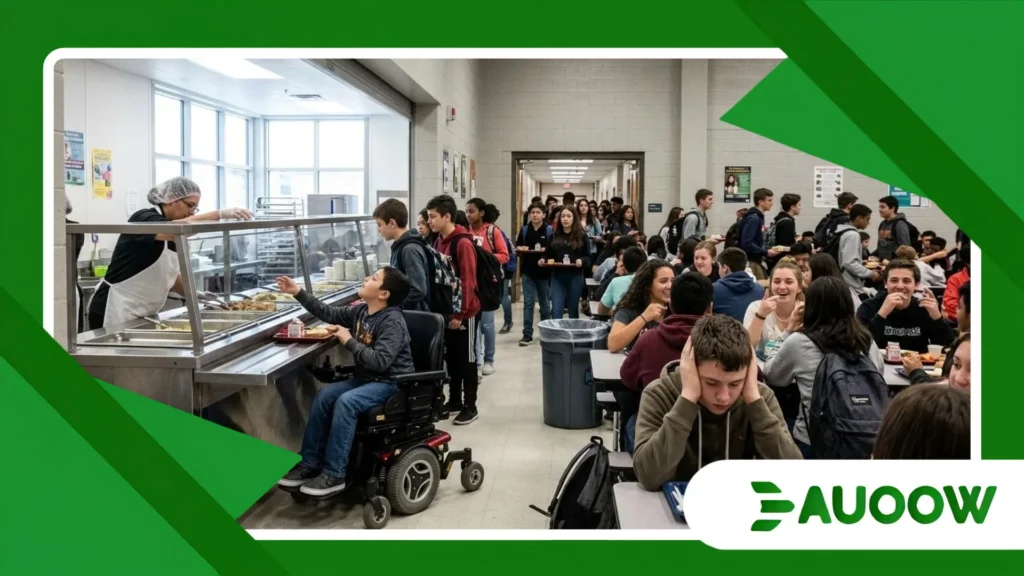
What rarely enters this debate is how many school cafeterias were originally planned around industrial throughput rather than human variation.
Built to move large numbers of students through a serving line in roughly twenty minutes, traditional lunchrooms often prioritize durable surfaces, fixed bench seating, and uniform counter heights.
There is a structural detail that frequently goes overlooked: fixed bench-style cafeteria tables can leave little or no room for a student using a wheelchair to pull up beside friends unless an end cap happens to be open.
Even then, the student may sit slightly apart from the group, angled sideways rather than integrated naturally into the conversation.
++ Making Online Assessments More Inclusive
What Happens When Sensory and Dietary Needs Are Overlooked?
Physical reach is only part of the picture. Fluorescent lighting strips, echoing gymnasium-style ceilings, and overlapping voices can create a sensory bottleneck that disproportionately affects neurodivergent students.
A student who appears “picky” or “disruptive” at noon is often reacting to predictable environmental triggers rather than choosing defiance.
At the same time, students with swallowing disorders, severe food allergies, or metabolic conditions frequently encounter rigid menu routines.
When cafeteria staff lack clear protocols or adapted utensils, families often end up packing meals every morning, which can quietly chip away at a familiar routine of peer belonging.
How Have Past Disability Laws Shaped Today’s Lunchroom Standards?
Looking closer, similar patterns appear across decades of public education reform.
Section 504 of the Rehabilitation Act of 1973 and the Americans with Disabilities Act (ADA) of 1990 established that federally funded schools cannot exclude disabled students from covered programs or activities, and the National School Lunch Program falls within that framework.
Under USDA regulations governing school meal programs, districts are generally required to provide reasonable meal modifications at no extra cost when a disability restricts a student’s diet.
Still, having a federal rule written on paper and seeing it run smoothly at 12:15 PM on a busy Tuesday are two very different realities.
++ How Student Voices Are Shaping Inclusive Education Policies
Where Does the Gap Between Written Policy and Daily Practice Appear?
In my reading of this landscape, the breakdown rarely comes from open refusal.
More often, it grows out of administrative silos where special education coordinators draft Individualized Education Programs (IEPs) without inviting food service directors into the room.
When food service teams are left out of IEP or 504 meetings, kitchen managers may learn about a student’s texture-modified diet or need for accessible school dining accommodations weeks after the semester begins.
By then, daily habits have hardened and students may already be retreating to the nurse’s office or an empty resource room to eat on their own.
Also read: The Growing Role of Universal Design for Learning in Modern Schools
What Does Inclusive Cafeteria Design Look Like in Practice?
Consider a documented shift carried out in several public districts across Massachusetts and Minnesota over the past few years, where occupational therapists audited school lunchrooms alongside nutrition directors.
Rather than launching an expensive structural renovation right away, teams often started with spatial redistribution and menu flexibility.
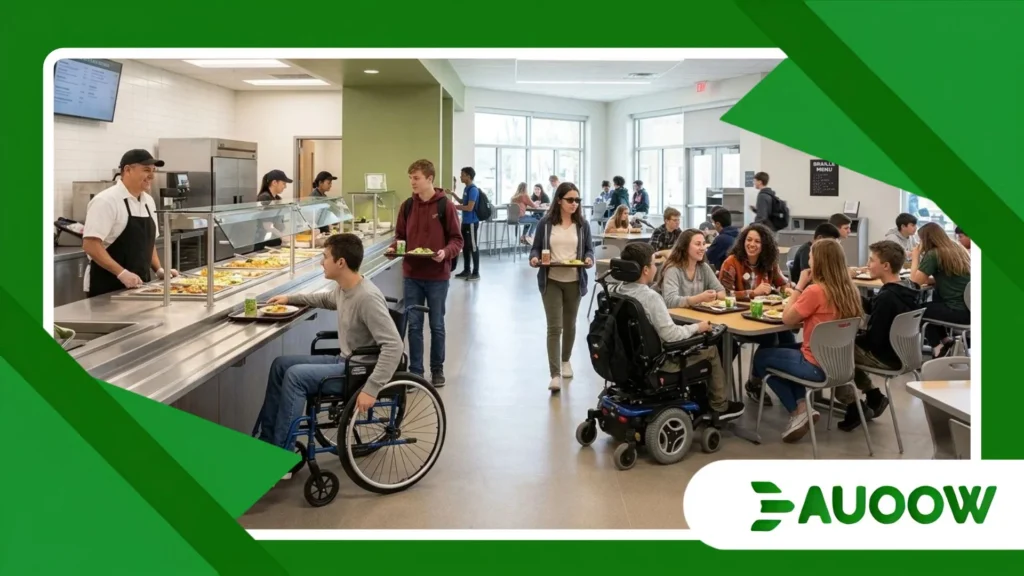
They swapped out roughly one-third of fixed-bench tables for height-adjustable, wheeled tables with clear knee space, placing them across the main floor instead of grouping them in a corner.
They also lowered tray rails by four inches and introduced high-contrast, picture-supported menu boards at eye level for students with low vision or intellectual disabilities.
How Do Small Operational Changes Protect Student Dignity?
Picture an eighth-grader with cerebral palsy who wants to eat independently without an aide hovering close behind her.
In a thoughtfully arranged lunchroom, weighted utensils, non-slip silicone mats, and pre-portioned finger-food options can help her manage her own tray while sitting directly across from classmates.
The most candid reading of these efforts suggests that accessible school dining works best when supports blend naturally into the room.
When quiet zones with acoustic baffling panels are open to any student looking for a calmer mealtime, neurodivergent students are less likely to feel singled out when stepping away from the main hall.
Why Must Cafeteria Staff Be Part of the Inclusion Team?
A ramp or a lowered counter means very little if the person standing behind the serving line feels rushed or unprepared.
Districts that invest even two hours of annual training for nutrition workers covering dysphagia safety, allergy cross-contact, and respectful communication often see fewer lunchtime incidents.
Cafeteria staff frequently observe daily routines that administrators miss from afar.
Giving them clear visual guides on modified trays and direct lines of communication with school nurses can turn the serving line from a point of friction into a steady everyday safety net.
How Do Specific Lunchroom Adjustments Improve Daily School Life?
To see how physical, sensory, and policy changes fit together, it helps to compare practical adjustments side by side rather than treating accessibility as a single box to check.
| Cafeteria Barrier | Practical Accommodation | Primary Beneficiaries | Daily Educational & Social Impact |
| Fixed-bench tables with no knee clearance | Mixed-height, freestanding tables distributed evenly across the dining hall | Students using wheelchairs, walkers, or posture-supportive seating | Supports face-to-face peer conversation without placing students at table ends |
| High serving counters and heavy trays | Lowered tray slides (32–34 inches), lightweight compartmentalized trays, and reach-assist tools | Students of short stature, wheelchair users, and students with upper-limb fatigue | Encourages independent food selection and reduces reliance on adult aides |
| Harsh acoustics and glaring overhead lights | Acoustic ceiling baffles, softer LED zones, and optional low-stimulation seating alcoves | Autistic students, students with ADHD, migraine sufferers, and sensory processing differences | Helps reduce midday sensory overload, supporting afternoon focus and emotional regulation |
| Uniform menus and text-heavy signage | Texture-modified options, adaptive utensils, and visual picture menus with allergen icons | Students with dysphagia, developmental disabilities, low vision, or severe allergies | Supports safe caloric intake and reduces the stigma of eating separate meals alone |
| Siloed IEP and food service communication | Including nutrition managers in 504/IEP reviews and standardizing medical diet forms | Students requiring medically necessary meal or seating modifications | Helps prevent early-semester service delays and builds consistent trust with families |
Why Does Investing in Accessible School Dining Strengthen the Entire School Community?
There are strong reasons to question any vision of educational equity that stops at the classroom door.
A student who gets through lunch feeling hungry, overstimulated, or set apart from peers can carry that exhaustion straight into afternoon classes.
Adequate nutrition, sensory recovery, and everyday social connection are not peripheral extras; they shape how well students can focus, learn, and participate throughout the afternoon.
When districts invest in accessible school dining, the gains often extend well beyond students with formal IEP or 504 plans.
Quiet acoustic zones can give anxious ninth-graders a calmer place to reset before an exam.
Flexible seating can help a student using crutches after a weekend sports injury move through the room more comfortably.
Clear visual menus can also help students who are still learning the local language navigate unfamiliar meals with greater confidence.
Over time, these ordinary design decisions send a steady message across the whole building: shared spaces are meant for everyone, and belonging should never require asking for special permission just to sit down and eat alongside peers.
Frequently Asked Questions
Are public schools legally required to provide modified meals for disabled students?
In many cases, yes. Under USDA regulations connected to Section 504 of the Rehabilitation Act and the ADA, participating schools are generally expected to provide reasonable meal modifications at no extra charge when a student’s disability restricts their diet, usually supported by a signed statement from a licensed healthcare professional.
How can parents request seating or sensory accommodations in the school cafeteria?
Parents can bring up cafeteria adjustments during an IEP or Section 504 meeting.
Useful options often include height-adjustable tables placed alongside peer seating, access to a quieter eating space, permission to wear noise-reducing headphones, or extra time to finish a meal.
Does making a school cafeteria accessible require a major construction budget?
Not necessarily. While structural updates help in older buildings, many practical steps such as rearranging tables for wheelchair clearance, mounting acoustic wall panels, providing adaptive utensils, and training nutrition staff can often be phased in using routine equipment and staff development budgets.
What if a student needs adapted utensils or feeding support during lunch?
Occupational therapists and school nurses can evaluate a student’s motor needs and document adaptive tools such as weighted spoons, plate guards, or non-slip mats within an IEP or 504 plan so those supports are available consistently during school meals.
Why should food service directors be invited to IEP or 504 meetings?
Bringing food service directors into planning conversations helps kitchen teams clarify allergy precautions, texture modifications, and serving-line adjustments early on, reducing miscommunication between special education staff and dining room workers.
