
How AI curriculum integration 2026 impacts inclusive education
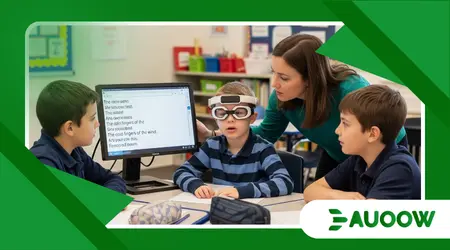
The impact of AI curriculum integration 2026 impacts inclusive education becomes visible not in a boardroom or a software lab, but in the quiet corner of a Grade 4 classroom in Halifax.
Ten-year-old Leo, who communicates primarily through a high-tech eye-tracking interface, is co-authoring a poem with three peers.
In the past, Leo might have been “integrated” in name only physically present, but intellectually isolated by the time-lag of manual translation.
Today, the curriculum itself is fluid. As the teacher introduces metaphors, Leo’s interface doesn’t just provide static symbols; it suggests conceptual bridges tailored to his specific linguistic patterns.
He contributes a line about “the wind’s cold fingers” at the exact moment his classmates are debating the imagery. There is a profound shift happening here.
We are moving away from the era of “accommodations” where we took a rigid, standard curriculum and bent it until it stopped breaking toward a systemic redesign where flexibility is the baseline.
Navigating the New Classroom Landscape
- From Static to Dynamic: Moving away from “one-size-fits-all” textbooks shifts the social hierarchy of the classroom, making room for diverse learning paces.
- The Literacy Evolution: Redefining “reading” and “writing” for students who navigate the world through non-traditional inputs.
- The Teacher’s New Role: The focus has shifted from mere content delivery to the orchestration of personalized learning paths.
- The Ethical Boundary: Addressing the “data-shadow” cast by students who rely on AI for their primary interactions.
Why does a personalized curriculum feel like a revolution?
For nearly a century, school systems were modeled on the factory: standardized inputs producing standardized outputs.
If you couldn’t process the input at the mandated speed, you were often moved to a “slower” line. In 2026, this model is finally losing its grip.
Because AI curriculum integration 2026 impacts inclusive education by dissolving the fixed pace of the classroom, we are seeing the end of the “average” student.
The real victory isn’t the AI itself, but the permission it gives teachers to stop being gatekeepers of a single path.
When the curriculum can auto-generate a high-interest version of a history text for a student with dyslexia, while providing complex primary-source analysis for another, the “gap” in the room stops being a source of shame. It becomes a simple logistical variance.
++ Why AI literacy in inclusive education is now a global priority
How do decisions from the 1990s impact your 2026 tech?
The digital “bones” of our current systems are still largely built on accessibility standards defined in the late 20th century.
Those early laws focused on physical access ramps and elevators and later, basic web compliance like alt-text for images. They were built on the idea of the “alternative format.”
When we observe with more attention, a pattern emerges: we often treat inclusion as an extra cost or a special favor.
However, the current shift toward AI integration is forcing a reconciliation with those old assumptions. “Bolted-on” accessibility is inherently fragile.
If a system update can break a student’s ability to “hear” their textbook, the problem isn’t the update it’s the fact that the hearing was never a core requirement of the design.
Also read: Gamification and Accessibility: Designing Play for Learning
What actually changed after the 2026 shift?
The transition from traditional “Special Education” silos to integrated AI-led environments has fundamentally altered the student experience.
| Year | Instructional Focus | Impact on Inclusion | Student Experience |
| 2015 | Digital textbooks & 1:1 iPads | Basic accessibility (text-to-speech) | Students often felt “different” using extra tools |
| 2021 | Remote learning & closed captions | Normalization of digital supports | Barriers reduced, but curriculum remained rigid |
| 2024 | Early Generative AI pilots | Personalized summaries and “tutors” | Increased workload for teachers to manage tools |
| 2026 | Integrated AI Curricula | Real-time multimodal content generation | Inclusion is seamless; every student’s path is unique |
The most significant change isn’t the tech, but the normalization of assistance.
When most students in the room use a digital agent to help organize thoughts or verify facts, the student with a cognitive disability who uses a similar agent to simplify syntax no longer stands out.
The stigma of the “special tool” is fading.
Why is the “Data Wall” the new barrier?
There are valid reasons to question the pace of this transition.
If AI curriculum integration 2026 impacts inclusive education without strict privacy safeguards, we risk asking students with disabilities to trade their data for their autonomy.
Consider a student who uses an AI-powered voice synthesizer. Every thought expressed and every frustration voiced is processed by a cloud-based model.
We are creating a “data-shadow” for these children that their peers may not have to carry.
We must ensure that the inclusive classroom doesn’t inadvertently become a surveillance state for the vulnerable.
Read more: Teacher Burnout and Inclusive Classrooms: How to Prevent It
Can a machine truly understand “Inclusive Pedagogy”?
Often, the most significant barrier isn’t the level of the text, but the cultural and social context of the learning. AI models are trained on historical data, which can carry deep-seated biases.
If an AI-integrated curriculum suggests examples that exclude the experiences of marginalized communities, it isn’t being inclusive it’s just being efficiently exclusionary.
Relying solely on algorithms to design “inclusion” is a dangerous shortcut. Inclusion remains a human, ethical act.
It requires a teacher who understands that Leo isn’t just a “user” of an eye-tracker, but a child who needs to feel his perspective is valued. The AI can provide the bridge, but humans must decide where the bridge leads.
What happens when the “Tech Gap” becomes the “Opportunity Gap”?
The massive disparity in funding between school districts remains a structural hurdle. In wealthy areas, AI curriculum integration 2026 impacts inclusive education provides a seamless, high-speed experience.
In underfunded schools, students may be left with “laggy” interfaces or older models that lack the nuance required for complex inclusion.
We risk creating a two-tier system of accessibility. In the first tier, AI empowers; in the second, it merely automates.
If a student’s ability to communicate in real-time depends on their local tax base, we haven’t solved an accessibility problem we’ve just rebranded an old inequality.
We must advocate for a universal baseline of AI accessibility, treating it as a public utility rather than a luxury.
Navigating the Future of Inclusive Classrooms
Ultimately, the success of AI curriculum integration 2026 impacts inclusive education will be measured by the “invisible labor” it removes. Success is found when a student has to think less about the technology and more about the ideas.
If Leo can spend his afternoon debating a poem rather than fighting with his calibration settings, the system is working.
If a teacher can focus on mentoring emotional growth rather than manually adapting 30 different worksheets, the system is working.
We must move toward an architecture of empathy, acknowledging that accessibility isn’t just a feature it is a human right.
Frequently Asked Questions (FAQ)
Does AI curriculum integration mean fewer teachers in the classroom?
No. It requires more skilled educators. The AI handles the mechanical part of differentiation, which allows the teacher to focus on complex social integration and critical thinking.
Will my child’s data be sold if they use AI in school?
This depends on local regulations. Many jurisdictions in 2026 have implemented “Sovereign Education Clouds” that keep student data private and prevent it from being used for commercial training or advertising.
Is AI reliable enough to support students with severe disabilities?
It is a tool, not a fail-safe. While 2026 models are highly accurate, they still require “human-in-the-loop” oversight to ensure interpretations are correct and that the student remains central to the conversation.
How do we ensure AI doesn’t teach biased views about disability?
This is the role of ongoing “Algorithmic Auditing.” Schools are increasingly requiring vendors to prove that their models have been tested for ableist bias and include diverse perspectives in their training data.
Can AI help with social inclusion, not just academic?
Yes. Some of the most successful integrations involve AI “social bridges” that help students navigate peer-to-peer cues in real-time, reducing the isolation that often accompanied traditional integration.
