
How AI Tutors Are Changing Learning Opportunities for Students with Disabilities
AI tutors are changing learning opportunities for students with disabilities in ways that feel less like a technological revolution and more like the quiet opening of a long-locked door.
I remember sitting in the back of a bustling high school library three years ago, watching Leo a brilliant sixteen-year-old with dyslexia struggle to parse a biology textbook.
He wasn’t lacking intelligence; he was trapped by the rigid, linear presentation of information that has defined public education since the Victorian era.
The page was a fortress, and he was being denied the keys. Last month, I spoke to Leo again. He wasn’t in a library corner.
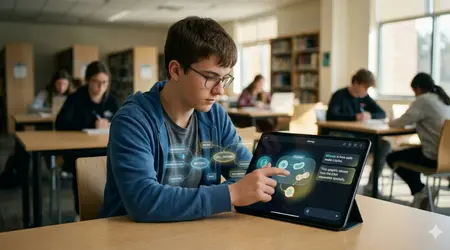
He was engaging with a customized AI interface that didn’t just read the text to him; it synthesized concepts, adjusted the vocabulary to his processing speed, and mapped out the biological processes in a spatial, visual format that finally matched how his mind actually works.
How the digital shift disrupts old barriers
Why customization beats standard curriculum
Moving beyond simple accommodation toward cognitive equity
The ethics of silicon-based pedagogical support
The Persistence of the One-Size-Fits-All Model

We have spent decades building educational infrastructure on a foundation of standardization.
For a long time, the legal push think of the early iterations of the Individuals with Disabilities Education Act (IDEA) in the United States or the Equality Act in the UK was focused primarily on physical access and the provision of basic materials.
We fought for ramps, and then we fought for Braille. These were essential, vital victories.
But what rarely enters into this debate is the fact that “access” was often conflated with “presence.”
We secured the right for students to be in the room, but we were far slower to challenge the pedagogical rigidity of the room itself.
The history of inclusive education is, in many ways, a history of trying to force diverse learners into a singular, industrial-era delivery system.
When we observe this pattern with more attention, it becomes clear why many students felt left behind. It wasn’t the disability that created the ceiling; it was the method of delivery.
The system relied on a singular, human teacher often overworked and under-resourced to somehow differentiate instruction for thirty different cognitive profiles simultaneously.
It was a mathematical impossibility that we essentially ignored for years, shifting the burden of failure onto the students themselves.
++ How multilingual inclusive education improves learning equity
Why Personalization is No Longer a Luxury
The emergence of these new tools signifies a shift in power.
AI tutors are changing learning opportunities by moving the student from a passive recipient of a standardized curriculum to an active curator of their own learning experience.
I have seen parents who, in the past, were forced to spend thousands of dollars on private tutors to translate school materials into accessible formats, now seeing their children gain autonomy overnight.
This is not about removing the human teacher; it is about liberating them from the role of information-delivery machines.
When an AI interface handles the initial processing the decoding, the simplifying, the summarizing the teacher is finally free to focus on the nuanced, socio-emotional work of mentorship.
There is a structural detail that is often ignored: the “norm” in education was never really designed for the neurotypical student either.
Also read: Inclusive Education in the Middle East: Emerging Opportunities
It was designed for the average, a statistical ghost that doesn’t exist in reality. By building tools that cater specifically to neurodivergent needs, we are actually refining the entire educational experience for everyone.
The silent shift in cognitive accessibility is perhaps the most significant development in modern pedagogy.
We must ask ourselves: what happens to a child’s self-perception when they stop viewing themselves as the problem? For years, the narrative has been that the student is “behind.”
Now, we are seeing evidence that the student was simply using the wrong interface.
When a tool allows a student with executive function challenges to break down a complex assignment into small, manageable milestones, their anxiety levels plummet.
Bridging the Gap: A Real-World Scenario
Consider the case of a university student in London who navigates life with profound physical mobility limitations and fluctuating fatigue levels.
In the past, this student would have been at the mercy of the university’s rigid attendance and lecture-recording policies. If they missed a session due to health complications, the opportunity for learning was effectively extinguished.
Read more: Africa’s Innovative Approaches to Inclusive Learning
Today, that same student uses a generative AI companion that monitors the lecture in real-time, generates high-quality transcripts, creates hyper-personalized flashcards, and allows the student to interrogate the lecture material through a conversational interface.
They are no longer dependent on the benevolence of a peer to share notes or the willingness of a department to adapt.
AI tutors are cha nging learning opportunities by creating a personal, always-available bridge that doesn’t require permission or extra funding to activate.
| Feature | Pre-AI Educational Context | Post-AI Educational Context |
| Material Access | Static, linear text; delayed | Dynamic, multi-modal; instant |
| Pacing | Fixed by the group schedule | Controlled by the individual |
| Support Source | Human dependency (limited) | Hybrid AI-Human (scalable) |
| Equity Focus | Retroactive accommodation | Proactive design |
The Ethics of the New Frontier
Of course, the analysis becomes less optimistic when we discuss the digital divide.
If these tools are only accessible to students in well-funded districts or affluent families, we are not solving inequality; we are merely updating its software.
The most honest assessment is that these technologies could either be the great equalizer or the ultimate segregators.
If we view these tools as optional “add-ons” rather than core components of public education infrastructure, we will see the gap between the haves and the have-nots widen significantly.
There are good reasons to question the rush to digitize. We must remain vigilant about data privacy and the potential for these systems to reinforce existing biases in our educational materials.
If an AI model is trained on a curriculum that historically marginalized certain histories or voices, it will simply repeat those omissions, only faster and more efficiently.
We cannot allow efficiency to replace critical thinking or human oversight.
Building a Future of True Integration
We are moving away from an era where inclusion was a checkbox exercise. The goal is to reach a point where the barrier to entry is lowered so significantly that “accommodation” becomes invisible.
When the tools are woven into the fabric of the classroom, we stop asking, “How can we make this student fit?” and start asking, “How can we make this environment responsive?”
AI tutors are changing learning opportunities by forcing us to acknowledge that the traditional classroom structure was a choice, not a necessity.
By decentralizing the delivery of knowledge, we are giving students the agency to learn in ways that honor their unique cognitive architecture.
The ultimate measure of this shift will not be in the sophistication of the algorithms we use.
It will be found in the classroom of the future, where a student no longer needs to advocate for their basic right to understand the lesson, because the tools of understanding are already in their hands.
We have the technical capacity to build a system that is fundamentally more humane. Whether we have the political and social will to make that universal is the question that remains unanswered.
FAQ: Navigating the New Landscape
Is this going to replace the role of classroom teachers?
No. It changes the nature of the role. Teachers currently spend too much time on repetitive tasks explaining the same concept five different ways to meet five different needs.
AI handles the delivery; teachers handle the connection, the motivation, and the complex guidance that no machine can emulate.
What happens if a school doesn’t have the budget for these systems?
This is the primary concern for any advocate. Access to these tools should be viewed as a basic educational right, similar to textbooks or internet access.
If governments don’t prioritize public funding for these tools, we will see a significant drop in equity for students who need them most.
Are these tools helpful for all types of disabilities?
They are versatile, but not a silver bullet. For students with mobility impairments or cognitive differences, they are revolutionary.
However, for those with specific sensory processing needs that require physical, tangible tactile experiences, AI must be paired with physical assistive technologies to be truly effective.
How do I know if the AI is giving my student accurate information?
The potential for inaccurate output is real. This is why human oversight remains non-negotiable.
These tools should be used as assistants, not as the final authority. We must teach students digital literacy how to verify sources and question what the machine provides.
Will this make students too dependent on technology?
It is more helpful to think of this as scaffolding rather than dependence. We don’t view glasses as a crutch; we view them as an enabler for visual clarity.
If an AI tool allows a student to grasp complex literature they previously couldn’t access, it isn’t dependency it is cognitive liberation.
