
Smart Home Features That Actually Improve Independence
Elena sits at her kitchen island, the soft glow of the late afternoon sun catching the edge of her tablet as she manages her morning emails.
A decade ago, this simple act of independence preparing a cup of coffee and transitioning to work without assistance was a logistical puzzle that required careful planning, physical exertion, and often, the help of a personal care assistant.
Today, smart home features that actually improve independence have quietly rearranged the geography of her domestic life, transforming the home from a place of managed limitations into a space of agency.
The change isn’t found in the flashiest gadgets or the most expensive automated furniture. It is found in the subtle, often overlooked friction points that have been smoothed away by thoughtful design.
While the tech industry frequently pivots toward “luxury convenience,” the real story of domestic autonomy is one of removing barriers that have stood for generations.
- The silent evolution of interior design
- When infrastructure meets human agency
- Redefining the boundaries of the home
- The gap between marketing and necessity
The Hidden History of Domestic Barriers

For much of the twentieth century, the home was designed for the “standard” inhabitant a construct that ignored the diversity of human mobility, sensory processing, and cognitive load.
If you look at the floor plans of suburban homes built in the 1960s, you see a clear adherence to rigid structural expectations.
Doorway widths, light switch placements, and the height of kitchen cabinetry were not neutral design choices; they were normative assertions.
When we talk about smart home features that actually improve independence, we aren’t just talking about a voice-activated lightbulb.
We are talking about the long-overdue correction of a design philosophy that favored the static user over the dynamic one.
The barriers weren’t merely physical; they were baked into the legislative and architectural standards that dictated how houses should be built and who they were “for.”
What remains largely unexamined is how much of our “modern” independent living is still reliant on outdated, rigid infrastructure. We have placed high-tech Band-Aids over deep, structural issues.
A smart lock is a wonderful convenience, but it does little for a resident if the threshold of the home remains physically inaccessible due to archaic zoning or construction codes that prioritized aesthetic uniformity over functional accessibility.
Where Technology Meets Human Needs
The most effective tools for autonomy are often the ones that disappear into the background.
In my years of analyzing urban and domestic spaces, I have observed that the most successful smart home features that actually improve independence are those that offer a sense of continuity.
They do not replace the user’s intention; they amplify it. Consider the role of climate and environment control.
For an individual with fluctuating motor control or chronic pain, the ability to regulate ambient temperature without navigating to a manual wall thermostat is not a luxury it is an energy-saving necessity.
When the physical act of reaching for a dial is eliminated, that energy can be redirected toward the tasks of the day. This isn’t just about comfort; it is about cognitive offloading.
++ How accessible public Wi-Fi systems affect digital inclusion today
The Problem with “Smart” Assumptions
Why does the market often get this wrong? There is a tendency to design for the “edge case” as a secondary thought, rather than the primary driver of development.
We see high-end smart mirrors or automated kitchens that cost more than a small car.
These products create a digital divide where autonomy becomes a privilege of the affluent, rather than a standard expectation of a dignified living environment.
The real challenge, and the one that often goes ignored in technical manuals, is interoperability.
A home that requires five different apps to manage basic lighting and entry is a home that is fundamentally inaccessible.
If a piece of technology introduces more complexity than it removes, it fails the basic test of inclusive design.
The Reality of Implementation
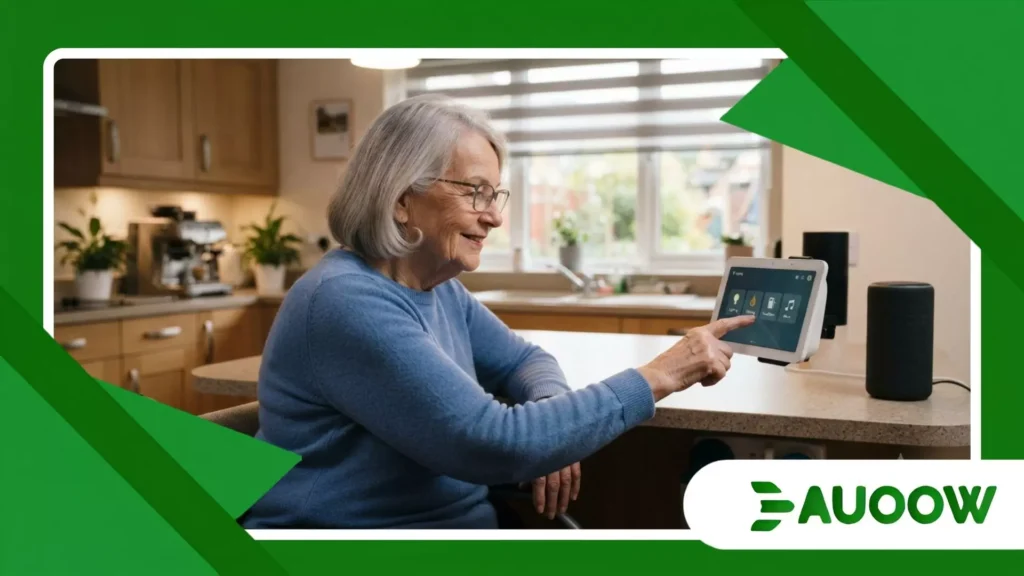
Let’s look at a concrete, if understated, scenario. Think of an older adult choosing to “age in place.” The goal isn’t to turn the home into a laboratory of sensors and surveillance.
The goal is to ensure that the house reacts to the person, rather than the person having to conform to the house.
A simple implementation of automated voice-controlled routines for window blinds and security systems can alter the daily rhythm for someone with limited grip strength or stamina.
These are the smart home features that actually improve independence precisely because they are quiet. They don’t demand attention; they simply provide a path of least resistance.
Also read: Why facial recognition accessibility raises daily access concerns
Legislative Hurdles and Structural Realities
It is vital to connect these shifts to the broader legislative landscape. In many jurisdictions, building codes have been painfully slow to adopt universal design principles.
While we celebrate the arrival of the “smart home,” we must ask ourselves why we needed such technology to compensate for bad architecture in the first place.
When we observe these patterns, we see that policy often trails behind innovation by decades.
The same frustrations that advocates faced in the 1980s regarding basic ramp access are now being echoed in the digital realm where interfaces are locked behind proprietary, inaccessible software.
We are effectively creating new digital silos, mirroring the physical ghettos of the past.
| Era | Focus of Accessibility | Primary Barrier |
| 1970-1990 | Physical infrastructure | Curbs, doorways, stairs |
| 1990-2010 | Digital awareness | Screen readers, basic web standards |
| 2010-2026 | Integrated autonomy | Proprietary tech, complex interfaces |
The Future of Living Spaces
What changed after this technological surge? The shift has been from “accommodation” to “anticipation.”
True smart home features that actually improve independence are moving toward proactive, rather than reactive, design.
This means a house that monitors for potential hazards like an unattended stove or a water leak not to surveil the inhabitant, but to provide a safety net that allows for more adventurous living.
There is a legitimate fear that we are over-digitizing our personal sanctuaries. But the perspective of someone who has lived through the limitations of an inaccessible home is often quite different.
For many, a sensor is not an invasion of privacy; it is a key to freedom. It allows one to take risks, to work, to host friends, and to exist in a space without the looming fear that a single misstep could lead to a loss of independence.
The most honest analysis suggests that we have only scratched the surface of what is possible. The future shouldn’t look like a sci-fi cockpit.
It should look like a home that is essentially “invisible” where the technology functions so well that we stop noticing it entirely, and instead, we just notice our own lives unfolding with greater ease.
Read more: The rise of smart crosswalk accessibility in urban mobility plans
Beyond the Gadgets
We must guard against the notion that technology is a totalizing solution.
The most sophisticated smart system in the world cannot replace the value of a physical environment that is fundamentally designed for everyone.
If we continue to build houses with narrow corridors and high cupboards, no amount of AI-driven automation will truly solve the problem.
Inclusive design is not a feature set you can buy in a box. It is a baseline standard of human dignity.
When we push for smart home features that actually improve independence, we are essentially demanding that the designers and legislators who shape our world finally stop building for the mythical “average” user and start building for the real, diverse, and brilliant humans who inhabit these spaces every day.
FAQ: Living Independently
Are these smart home features difficult to set up for someone with limited mobility?
The initial setup can be challenging, but many services now offer professional installation tailored to accessibility needs. The goal is a “set it and forget it” environment.
Do these technologies require high-speed internet to function?
Most do, which remains a significant hurdle in rural or underserved urban areas. Ensuring robust, stable connectivity is just as essential as the hardware itself.
How do I protect my privacy while using these systems?
It is a valid concern. Opt for devices that offer local processing (where data stays in your home rather than the cloud) and always choose strong, unique passwords for every connected device.
Is it really necessary to spend a lot of money to see these benefits?
Not necessarily. Many of the most impactful changes come from low-cost, off-the-shelf items like smart plugs, motion-activated lights, and voice-controlled hubs.
Start small with the areas of your home that cause the most daily frustration.
What should I prioritize if I have a limited budget?
Focus on safety and energy. Lighting, temperature control, and automated door locks usually provide the highest return on investment regarding daily autonomy and peace of mind.
