
The Future of Accessible Public Transportation Policies
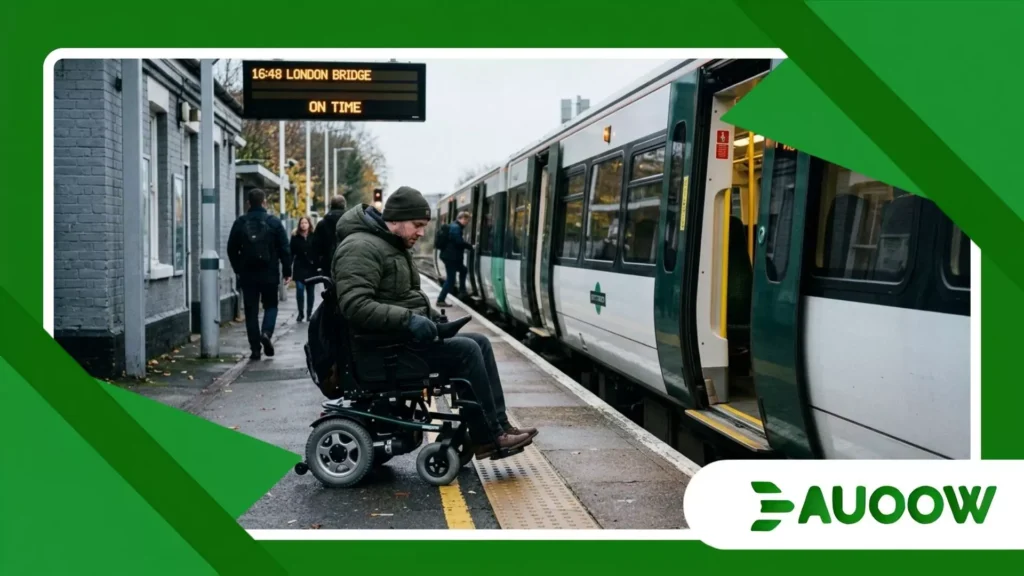
When Marcus waited on a freezing platform in South London last November, the display board insisted his train was on time.
But when the four-car commuter train glided to a stop, the gap between the carriage floor and the platform edge was nearly eleven inches a drop that made it completely impossible for his motorized wheelchair to cross without a manual ramp.
The station guard on duty had been reassigned due to staff cutbacks, leaving Marcus watching three consecutive trains depart while he waited for assistance.
His experience illustrates why the future of accessible public transportation policies must address the quiet disconnect between legal rights on paper and physical realities on the ground.
What We Cover in This Article
- The Broken Chain of Urban Transit: Why a single broken link invalidates entire accessible transit networks.
- Legacy Systems and Modern Law: How historic architecture collides with contemporary disability legislation.
- Data Driven Disparity: Why digital transit updates often fail the passengers who need them most.
- Comparative Policy Evolution: A detailed overview of transit mandates across key global regions.
- Editorial Perspectives: Direct answers to pressing questions surrounding the transit access landscape.
Why do modern transit networks still leave commuters stranded?
For decades, urban transit planning treated physical access as an isolated mechanical problem solved by adding ramps, elevators, or dedicated seating.
Yet, if a commuter successfully boards a low-floor bus only to find the destination stop blocked by parked vehicles or an unplowed snowbank, the trip fails entirely.
What rarely enters this debate is the concept of whole-journey accessibility. Transit systems do not operate in a vacuum.
A journey consists of several interconnected links: arriving at the stop, navigating the station, boarding the vehicle, receiving real-time announcements, and exiting safely into the surrounding sidewalk network.
When we look closer at daily transit routines, the pattern repeats across major metropolitan areas worldwide.
A city spends millions on low-floor vehicles, yet leaves station elevators out of service for weeks due to delayed maintenance contracts. The barrier is rarely an absence of engineering capability.
Rather, it stems from fragmented administrative oversight, where transit agencies manage the vehicles while municipal public works departments maintain the sidewalks and bus stops.
++ How Inclusive Urban Planning Strengthens Communities
How do decisions made decades ago dictate today’s journeys?
To understand why so many subways, trams, and rail lines remain difficult to navigate, we must trace their physical roots.
Much of the world’s urban transit infrastructure was constructed long before disability civil rights statutes took shape.
In cities like New York, London, Paris, and Tokyo, subterranean networks were built deep underground during periods when spatial efficiency and rapid throughput were the sole engineering metrics.
Staircases were cheap and compact; elevators were viewed as unnecessary luxuries reserved for heavy freight.
When landmark legislation like the Americans with Disabilities Act of 1990 or the UK’s Disability Discrimination Act of 1995 came into effect, transit authorities inherited massive networks of concrete and iron that were structurally hostile to retrofits.
There is a structural detail that is usually overlooked in municipal planning meetings: retrofitting an existing underground station often costs up to ten times more than incorporating universal accessibility features during initial construction.
Installing an elevator into a century-old station requires re-routing high-voltage utility lines, underpinning historical foundations, and acquiring expensive urban real estate for surface entry points.
Because transit authorities face finite capital budgets, they frequently prioritize quick cosmetic upgrades over deep structural retrofits.
Consequently, transit networks end up with “accessible island” systems handfuls of modernized hub stations surrounded by dozens of inaccessible neighborhood stops.
As we analyze what the future of accessible public transportation policies demands, transit planners must move past piecemeal updates and systematically target these network gaps.
Also read: Why Accessible Digital Identity Systems Matter
What happens when digital information becomes an obstacle?
Physical barriers are only half the equation. Over the last decade, transit agencies shifted heavily toward digital platforms, mobile apps, and automated ticketing kiosks to streamline operations and cut personnel costs.
Consider what happens when technology is built without inclusive feedback: a commuter with low vision tries to use a touchscreen ticket kiosk that offers no audio prompt or tactile surface, or a deaf passenger misses a vital rerouting announcement because the driver announced it only over a loudspeaker.
Digital updates were supposed to make transit smoother, yet they frequently create fresh obstacles when designed without inclusive standards.
Screen readers struggle with poorly coded transit apps, real-time arrival signs lack audio triggers, and touchscreen ticket machines remain unreachable for wheelchair users.
When digital infrastructure fails, it cuts off access just as effectively as a broken elevator.
Read more: The Growing Push for Accessible Government Websites
Why must transit authorities look beyond minimum legal compliance?
For decades, public policy regarding accessibility operated on a model of regulatory compliance. Municipalities did just enough to avoid lawsuits or fulfill statutory minimums.
This legalistic approach has reached its practical limit. Compliance guarantees that a ramp meets a specific incline ratio, but it does not guarantee that the ramp will be cleared of ice, or that the connecting doorway will be unlocked during operational hours.
When we observe transit systems globally, the most effective networks are moving beyond pure legal compliance toward Universal Design principles.
Universal Design does not focus on creating special features for specific populations; it focuses on making environments usable for everyone without requiring adaptation.
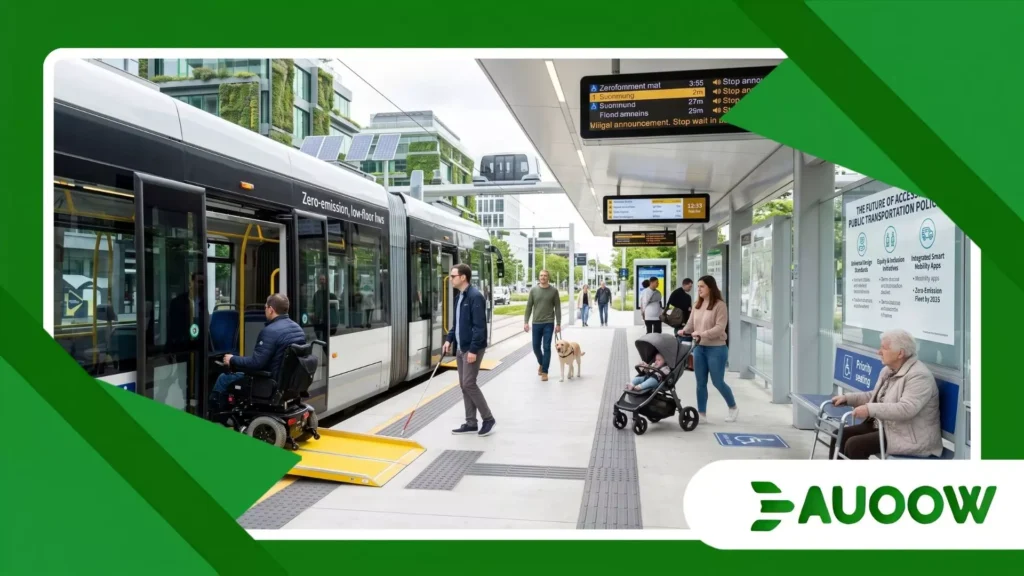
Level boarding on light rail systems serves as a prime example.
Eliminating the step between platform and train car allows wheelchair users to board independently, while simultaneously speeding up boarding for parents pushing strollers, travelers hauling luggage, and elderly passengers with reduced mobility.
By adopting this mindset, the future of accessible public transportation policies shifts from a burden of legal compliance to an investment in overall system efficiency.
When boarding becomes seamless for every commuter, dwell times at stations decrease, train schedules become more reliable, and overall operational performance improves for the entire city.
How do staff cutbacks impact daily independent travel?
In recent years, transit operators facing fiscal pressures have increasingly automated stations and reduced front-line personnel.
While digital kiosks save money on paper, removing human staff creates serious vulnerabilities for passengers who need assistance.
When platform staff or station managers are absent, a single broken elevator turns from a minor delay into an insurmountable barrier.
Disabled passengers are often forced to wait hours for mobile assistance teams to arrive, or they are advised to travel several stations past their intended destination to find an operational exit.
Independent travel requires predictability; without reliable staff support or well-maintained hardware, that predictability vanishes.
How do suburban and rural transit deserts deepen social isolation?
While urban centers gradually modernize their subway systems and bus fleets, suburban and rural communities present a starkly different picture.
In non-urban areas, public transit is often sparse, infrequent, or completely non-existent.
In many suburban developments, bus routes operate on two-hour headways, stops consist of a bare pole placed on a grass shoulder without sidewalks, and paratransit services require advance bookings up to 48 hours in advance.
For individuals who do not drive due to physical, visual, or cognitive conditions, this lack of infrastructure creates severe transit deserts.
Paratransit services, while essential, frequently act as a secondary, unequal system. Users endure long waiting windows, rigid scheduling rules, and shared rides that turn a simple ten-minute trip into a two-hour journey.
When suburban communities fail to integrate accessible fixed-route transit, disabled residents are effectively cut off from employment, healthcare, and community life.
Addressing this gap requires regional policy frameworks that extend accessibility mandates beyond city centers into the surrounding regions where millions live.
Comparative analysis of transit access frameworks
To understand how global policy frameworks approach these challenges, it helps to examine how different regions structure their mandates, funding models, and enforcement mechanisms.
| Region / Policy Framework | Primary Legislative Basis | Key Enforcement Mechanism | Major Policy Strength | Persistent Structural Bottleneck |
| United States (ADA Title II) | Americans with Disabilities Act (1990) | Federal DOT audits and civil litigation | Strong legal standing for individual claims | Severe funding gaps for legacy subway retrofits |
| European Union (EAA Directive) | European Accessibility Act (2019/2025) | Member state regulation and market oversight | Standardizes digital & physical transit tech across borders | Uneven implementation speeds among member nations |
| United Kingdom (PSVAR) | Public Service Vehicles Accessibility Regs | Driver and Vehicle Standards Agency (DVSA) | Rigorous fleet compliance standards for buses | Fragmented station staffing cutbacks hit commuter rail |
| Japan (Barrier-Free Act) | Act on Promotion of Smooth Transportation | Ministry of Land, Infrastructure, Transport (MLIT) | Exceptionally high platform-to-train level boarding | Complex navigation in massive private rail interchange hubs |
Moving Beyond Paper Guarantees to Real-World Mobility
Creating an accessible public transportation system requires more than good intentions and occasional vehicle upgrades.
It demands systemic policy changes, sustained capital investment, and direct involvement from the communities who rely on these services daily.
First, transit authorities must adopt whole-journey planning frameworks that evaluate accessibility from a passenger’s front door to their final destination.
This means coordinating transit schedules directly with municipal street maintenance, ensuring sidewalks, curb ramps, and crosswalks receive equal priority during capital planning and winter maintenance.
Second, digital infrastructure must be treated with the same accessibility rigor as physical hardware.
Real-time elevator status data, visual departure displays, and audio announcements must be built using open-source, fully accessible standards so third-party mapping apps can route passengers around broken equipment before they arrive at a station.
Finally, policy shaping the future of accessible public transportation policies must guarantee that disabled people hold leadership roles on transit governance boards and planning committees.
Decisions made about public space are far more effective when guided by those who live with their practical outcomes every day.
Upgrading infrastructure takes time, but the policies governing how we maintain, fund, and operate our networks can change immediately.
When transit systems are built to welcome everyone, they create stronger, more connected, and economically vibrant cities for the entire public.
Editorial FAQ
Why is paratransit alone insufficient for accessible urban transit?
Paratransit provides door-to-door rides for individuals unable to use fixed-route systems, but it often operates with strict scheduling constraints, long wait times, and high operating costs per trip.
While paratransit remains a critical safety net, expanding fully accessible fixed-route buses and trains gives passengers greater independence, spontaneous travel options, and lower long-term costs for transit agencies.
How do level-boarding platforms improve transit efficiency for all riders?
Level boarding eliminates the height gap between station platforms and train floors, allowing passengers using wheelchairs, pushing strollers, or carrying luggage to board quickly and independently.
This design speeds up passenger flow, reduces dwell times at stations, improves route punctuality, and lowers injury risks for both riders and transit staff.
Are legacy subway systems legally required to become fully accessible?
Under laws like the Americans with Disabilities Act (ADA) and similar international regulations, legacy transit operators are legally mandated to make “key stations” accessible during major renovations and ensure that all new construction adheres to strict accessibility standards.
However, because retrofitting century-old underground infrastructure is technically complex and capital-intensive, full network accessibility remains an ongoing process in many older cities.
What role does open-source transit data play in improving daily journeys?
Open-source transit data allows software developers to integrate real-time accessibility updates such as out-of-service elevators, escalator maintenance, or platform changes directly into mainstream navigation apps.
When riders receive accurate, up-to-the-minute information before starting their journeys, they can avoid broken infrastructure and select accessible routes without unexpected delays.
