
Why disability voting access is a major issue in 2026 elections
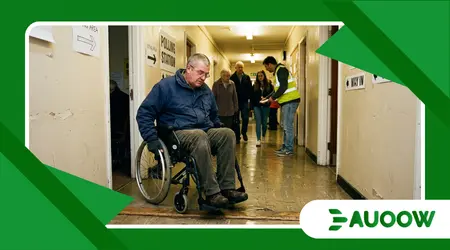
The scent of damp pavement and the hum of fluorescent lights in a polling station are memories etched into Elias’s mind not as a celebration of civic duty, but as a grueling endurance test.
He leans against his wheelchair in a narrow, labyrinthine corridor, eyes scanning the uneven floor for a path that doesn’t involve navigating a two-inch threshold.
For Elias, a seasoned voter with a keen interest in policy, the reality that disability voting access is a major issue isn’t a headline; it is the physical friction he encounters whenever he attempts to participate in democracy.
He is not fighting a ballot; he is navigating architecture, indifferent planning, and the silent assumption that the “average” voter walks through the door unencumbered.
- How physical design dictates political participation.
- The psychological cost of systemic exclusion.
- The evolution of digital barriers in an analog system.
- Moving beyond compliance toward genuine enfranchisement.
The Architecture of Exclusion
We often speak of the “right to vote” as an abstract, untouchable pillar of society. Yet, when we step outside the rhetoric, we find the mechanics of voting deeply entangled with the legacy of urban planning.
Many polling stations are housed in buildings constructed decades, sometimes a century ago. These structures were designed with a specific human form in mind one that moves fluidly, climbs stairs, and navigates tight corners without second thought.
When we consider that disability voting access is a major issue, we must confront the fact that we are retrofitting 19th-century infrastructure for a 21st-century democracy.
It is a messy, incomplete process. Every time a county clerk relocates a polling place to a “more accessible” location, they often move it into a community center that meets the bare minimum of the Americans with Disabilities Act (ADA) but fails to offer a dignified experience.
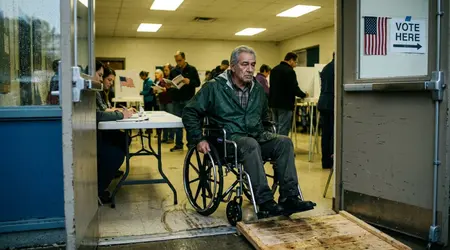
What rarely enters the mainstream debate is the concept of “dignified access.” A temporary metal ramp bolted to a back entrance is technically compliant.
It satisfies the letter of the law. But it signals to the voter that their presence is an afterthought a logistical hurdle to be managed rather than a citizen to be welcomed.
This is where the barrier becomes psychological. When a voter must summon a poll worker to operate a side door, the private act of voting is immediately stripped of its independence.
Invisible Threads: The Policy Legacy
The persistence of these hurdles is not merely a product of neglect; it is a manifestation of how we have historically codified participation.
In many jurisdictions, policies were drafted when “voter turnout” meant a physical presence in a designated space at a set time.
By enshrining these specific habits into law, we created a rigid structure that struggles to absorb the diversity of human capability.
When we look at the legislative history, we see a pattern of incrementalism. Laws have been passed to mandate accessibility, but enforcement mechanisms often lag behind political cycles.
The result is a patchwork of experiences. In one district, a voter might find a state-of-the-art electronic marking device.
Ten miles away, a voter might be handed a magnifying glass and a ballot with font sizes that defy readability.
++ Disabled People in Politics: Structural Barriers Beyond Discrimination
The Digital Paradox in Modern Civic Life
The rise of digital assistance has been hailed as a great equalizer, yet it has introduced a new layer of complexity.
As we transition toward electronic ballots and remote options, we have seen an explosion in assistive technology. This is positive. However, the software powering these devices is frequently siloed.
It is rarely designed with the same interoperability we expect from our personal devices. When disability voting access is a major issue, it is because the digital tools are often cumbersome, counterintuitive, or prone to crashes that occur at the worst possible moment.
We have to ask: who is testing these interfaces? Is it the engineers in a lab, or is it the people who rely on screen readers and switch devices daily?
There is a structural detail that is frequently ignored: the reliance on proprietary systems that do not talk to one another.
If a voter is accustomed to a specific accessibility configuration, encountering an alien interface in a high-pressure environment is not just an inconvenience; it is a deterrent.
The Human Cost of Delayed Progress
Let us consider the story of Sarah, a teacher who experiences tremors and requires specific adaptive hardware to sign documents.
For Sarah, the voting process is a calculated risk. She spends weeks researching candidates, deeply engaged in the issues that affect her community.
Yet, she approaches Election Day with anxiety. Will the machine be calibrated correctly? Will the staff know how to troubleshoot the error code that appeared last time?
Sarah’s experience is a reflection of a broader systemic fatigue. When citizens face repeated obstacles, the temptation to opt out to retreat from the process entirely becomes overwhelming.
This is not apathy. It is a rational response to a system that makes the exercise of rights feel like a negotiation.
Also read: Disability Rights in Africa: Emerging Leaders in Inclusion
Why the Pattern Repeats Itself
When we observe this phenomenon with scrutiny, the pattern repeats across regions. Policies are written, mandates are issued, but the execution remains localized and variable.
This decentralization of election administration is meant to protect the integrity of the vote. In practice, it often allows accessibility to be treated as a secondary priority a budget item to be cut when funds are tight.
If we acknowledge that disability voting access is a major issue, we must also acknowledge that it is a failure of imagination.
We continue to treat accessibility as an add-on, a feature to be bolted onto the system, rather than the foundational requirement for a representative democracy.
We assume the system is functioning correctly, and that the “bugs” are mere glitches. But what if the system was never truly designed to be inclusive in the first place?
Read more: Accessibility Policies in India: Progress and Pitfalls
The Evolution of the Poll Worker’s Role
The burden of this gap falls heavily on the shoulders of the volunteer poll workers.
These individuals are often tasked with becoming experts in human rights, technology, and conflict resolution in a single training session. It is an impossible ask.
We expect them to facilitate a seamless experience while operating under tight constraints.
When the process breaks down, it is usually the poll worker who feels the heat, not the policy architects who designed the system.
This creates a culture of frustration where both the voter and the volunteer are set up to fail.
Moving Toward a Holistic Solution
If we are to shift the needle, we must stop viewing the ballot box as the only site of engagement.
Accessibility starts months before Election Day in the design of the website where voters find information, in the clarity of the mail-in ballot instructions, and in the communication strategy of the campaigns themselves.
The most honest analysis suggests we are currently in a transition period. We are moving away from a model of “accommodation” toward a model of “universal design.”
The former treats accessibility as a favor granted to a specific group; the latter treats accessibility as the baseline for everyone.
What actually changed after this?
| Phase | Accessibility Approach | Typical Outcome |
| Past (Compliance) | Retrofitting existing buildings. | “Separate but equal” entrances. |
| Present (Digital) | Electronic ballot markers. | Better tech, but poor user interface. |
| Future (Universal) | Integrated digital-physical design. | Inclusive participation by default. |
When disability voting access is a major issue, it serves as a wake-up call that the status quo is brittle. We cannot simply rely on the hope that individual workers will be helpful.
We need systematic, durable, and universally accessible pathways that do not require the voter to advocate for their own rights while standing in line.
We must also question why the conversation around voting rights so often excludes the nuances of physical and cognitive disability.
We talk about ID laws, hours of operation, and mail-in ballots. But we rarely talk about the sensory environment of the polling place, the cognitive load of a complex ballot, or the physical barriers that make entry impossible for many.
Reframing the Civic Contract
The ultimate test of a democracy is not how it treats its most vocal constituents, but how it accommodates its most marginalized ones.
When we design for the most vulnerable, we inevitably improve the experience for everyone. A clearly marked, easy-to-navigate entrance benefits the elderly, parents with strollers, and those with temporary injuries.
An intuitive, high-contrast digital interface benefits the aging population and those with vision impairments.
There are good reasons to be skeptical of quick-fix solutions. Technology alone will not solve a problem rooted in institutional apathy.
We need a fundamental shift in how election officials prioritize accessibility. It must be at the table from the initial planning stages, not added to the budget proposal as an afterthought.
The conversation is shifting, however. There is a growing awareness that disability voting access is a major issue, and that awareness is the first step toward genuine reform.
As we look ahead, the challenge will be to translate that awareness into consistent, nationwide standards that respect the autonomy and dignity of every single voter.
FAQ Editorial
Is it really that difficult for someone with a disability to vote today?
It varies wildly. While many stations are prepared, others still rely on outdated buildings and poorly maintained equipment.
For many, the challenge isn’t just “can I vote,” but “can I vote independently and privately?” Often, the burden of overcoming barriers falls on the voter themselves, which is a major point of frustration.
What is the biggest hurdle to improving voting access?
Funding and standardized training are the primary bottlenecks. Because election administration is highly decentralized in many regions, there is no single “fix.”
Change has to happen at the local, county, and state levels simultaneously, which makes progress feel slow and fragmented.
Are digital tools making things better or worse?
Both. They have the potential to make voting much easier for those who cannot navigate paper ballots.
However, if the software is poorly designed or the hardware is unreliable, it creates a “digital wall” that can be more intimidating than the physical barriers they were intended to replace.
How can voters advocate for better accessibility?
Start by contacting your local election office and asking specific questions about their accessibility plans.
You can also volunteer to serve as an election monitor or advocate for “Universal Design” policies at local city council meetings. Data and personal stories are the most powerful tools for local change.
Why is this issue gaining so much attention in 2026?
The 2026 cycle is seeing an increased intersection between civil rights, technology, and aging populations.
As more voters demand equitable access and technology becomes more central to our daily lives, the gap between what is possible and what is provided has become impossible to ignore.
