
How AI curriculum for kids 2026 reshapes inclusive classrooms early
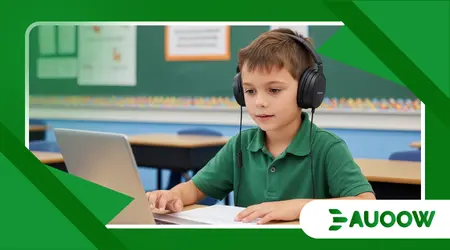
The promise of an AI curriculum for kids 2026 begins not with a computer chip, but with a third-grader named Leo.
For the first time, he isn’t waiting for an aide to translate a worksheet. Leo lives with dysgraphia; the physical act of holding a pencil often feels like trying to write with a chopstick in a windstorm.
In a traditional classroom, Leo might have been labeled a “slow” learner, his intellect trapped behind a wall of cramped muscles.
Today, however, he speaks to a refined, school-sanctioned interface that understands his specific speech patterns, transforming his brilliant, scattered thoughts into a structured essay on marine biology.
Leo isn’t just using a tool; he is participating in a pedagogical shift that treats cognitive diversity as a variable to be solved, rather than a burden to be managed.
We are witnessing a moment where the binary of “general education” versus “special education” is beginning to blur into something more fluid and, frankly, more dignified.
The shift toward intelligent classrooms involves:
- Customized learning paths that adapt to individual sensory needs.
- Tactile and auditory interfaces replacing visual-only data.
- The move from assistive tools to inclusive-by-design curricula.
- Teacher empowerment through real-time cognitive mapping.
- Ethical safeguards for the most vulnerable young learners.
Why are we moving toward an algorithmic classroom now?
The push for an AI curriculum for kids 2026 is born out of a realization that previous attempts at inclusion were often just “integration.”
We put students with disabilities in the same room but gave them different tasks, essentially creating islands of isolation within the main classroom.
This happened because teachers, despite their best intentions, are human beings with finite time. They cannot create thirty different versions of a lesson plan every morning.
What rarely enters this debate is the fact that the curriculum itself was often the barrier. Historically, education was built on a “factory model” designed for a mythical average student.
When a student didn’t fit that mold, the system didn’t change the mold; it tried to “fix” the student.
AI changes this by making the curriculum itself elastic. It is no longer a static book, but a responsive environment that meets the child halfway.
++ How AI curriculum integration 2026 impacts inclusive education
How does early AI literacy reshape the social fabric of school?
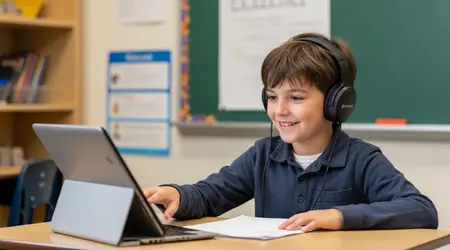
There is a structural detail that used to be ignored in school design: the psychological toll of being “the kid with the helper.”
When a student requires a constant human shadow to participate, they are often socially sidelined. In the context of an AI curriculum for kids 2026, the assistance is embedded into the environment.
It is ubiquitous. When every child is using an intelligent tutor or a generative brainstorming partner, the student with a disability no longer stands out as “different.”
The real innovation here isn’t the software; it’s the removal of the stigma.
By teaching all children how these systems work, we are creating a generation that views cognitive and physical support as a standard part of the human-technology interface.
This early exposure ensures that accessibility isn’t something “added on” later in life it is a foundational expectation.
Does this tech solve the “isolation” problem?
In the past, we relied on rigid laws like the Individuals with Disabilities Education Act (IDEA) to provide “reasonable accommodations.”
While these laws were revolutionary, they often resulted in a legalistic approach to inclusion checking boxes rather than fostering belonging.
A more honest analysis suggests that while laws open the door, it is the daily classroom experience that determines a child’s self-worth. AI allows for “stealth inclusion” where support is high-tech but low-profile.
Also read: Inclusive Education in the Middle East: Emerging Opportunities
Why did traditional classrooms take so long to adapt?
The barrier was never just financial; it was philosophical. For decades, the prevailing assumption was that “fairness” meant everyone getting the same thing.
It took time for the educational establishment to realize that fairness actually means everyone getting what they need to reach the same goal.
When we look back at the late 2010s, we see a graveyard of “educational software” that was little more than digital flashcards.
The arrival of an AI curriculum for kids 2026 marks the end of that era. We are moving toward systems that can detect a student’s frustration levels through their typing cadence or eye-tracking patterns.
There are valid reasons to question the privacy implications of this which we must but the benefit is a classroom that recognizes when a student is falling behind before the student even realizes it themselves.
Think of a skilled teacher, stretched thin by a class of thirty, trying to balance the official curriculum with the needs of an autistic student who feels overwhelmed by noise.
In the past, that student might have been sent to a “resource room.”
Today, an adaptive audio system can create a zone of focus for that student, filtering the frequencies that cause anxiety while allowing them to hear the teacher’s voice with clarity.
This is the practical application of contemporary acoustics and machine learning.
What actually changed in the classroom after 2024?
| Feature | The 2020 Classroom (Integration) | The 2026 Classroom (Inclusion) |
| Lesson Delivery | One-size-fits-all lecture | Multi-modal, AI-adapted delivery |
| Assessment | Standardized paper tests | Continuous, skill-based cognitive mapping |
| Support | Human aides (limited availability) | Embedded AI agents (24/7 support) |
| Peer Interaction | Sidelined by physical barriers | Tech-enabled collaborative play |
| Curriculum | Rigid, textbook-based | Elastic AI curriculum for kids 2026 |
Is there a risk of “Algorithm-Driven” segregation?
There is a valid concern that by letting AI handle specific learning needs, we might see a new form of digital segregation.
If a child spends all day interacting with a bot instead of a peer, have we actually included them? This is why the human element remains the most critical component.
AI should not replace the teacher; it should liberate them from the clerical work of “adapting” materials so they can focus on the emotional and social development of the child.
There is a subtle structural choice being made in these new curricula: are we teaching kids to use AI, or are we teaching them how AI works?
For kids with disabilities, understanding the “how” is a matter of autonomy. If they understand the logic behind the tool, they can advocate for better tools.
If they are merely passive users, they remain at the mercy of whatever a developer thinks they need.
Read more: Africa’s Innovative Approaches to Inclusive Learning
How do we safeguard the ethics of a “Smart” classroom?
There are good reasons to question the collection of data on children. A curriculum that tracks a child’s every hesitation can also be used to label or limit them.
We must be ethically cautious. The data generated in the pursuit of inclusion must be “owned” by the student and the family, not the software provider. We cannot trade a child’s privacy for their accessibility.
The most successful implementations of an AI curriculum for kids 2026 are those built on transparency.
Schools that show parents exactly how the AI is adjusting the reading level for their dyslexic daughter, and how that data is purged at the end of the term, are the ones building real trust.
Accessibility without trust is simply surveillance with a kinder face.
What are the long-term impacts of early AI literacy?
If we get this right, we are training a generation that will enter the workforce with no memory of a world where they couldn’t participate.
Imagine a student who grew up using voice-to-code AI in fifth grade; by the time they reach university, they won’t be asking for “special permission” to use assistive tech.
They will be the ones designing the next generation of inclusive infrastructure.
The most honest analysis suggests we are at the end of the “remedial” era of education.
We are moving toward a “generative” era. In this world, the AI curriculum for kids 2026 serves as the foundation for a society where the burden of adaptation shifts from the individual to the environment.
This is the ultimate goal of accessibility: a world so well-designed that the concept of “disability” becomes a historical footnote a reminder of a time when our tools were too primitive to see us for who we were.
Frequently Asked Questions (FAQ)
Will AI replace the need for Special Education teachers?
No. If anything, it makes them more vital. The teacher’s role shifts from being a “converter” of materials to a strategist of learning.
AI can provide content, but the teacher provides the social context, the empathy, and the guidance that no algorithm can replicate.
How does an AI curriculum help non-disabled students?
Universal design benefits everyone. Just as curb cuts help people with strollers and bikes, AI-adapted lessons help students who are English language learners, those with temporary injuries, or those who simply learn better through audio than text.
It fosters a flexible mindset for all.
Is this technology affordable for public schools?
While initial costs are high, the potential for long-term impact is significant.
Reducing the reliance on specialized physical materials and minimizing administrative burdens allows resources to be redirected toward more meaningful human interventions.
Many regions are now treating AI infrastructure as a core public utility.
What about children who cannot use screens or traditional tech?
In 2026, AI isn’t confined to screens. It lives in haptic wearables, smart toys, and spatial audio systems.
Inclusion means moving beyond the keyboard to create a sensory-diverse environment where interaction happens through movement, sound, or eye-gaze.
How do we prevent AI from inheriting the biases of the past?
This is a major challenge. If the data used to train AI doesn’t include the voices and experiences of people with disabilities, the AI will default to the “standard” student.
We must demand that curriculum developers use inclusive datasets and involve the disability community in the design process from day one.
